Can A Portable Car Battery Charger Be Used For Motorcycles?
If you own a motorcycle and a car, you might have wondered if you can use the same portable car battery charger for both vehicles. It seems logical—after all, both vehicles use batteries, and carrying one charger is much easier than keeping separate ones. But is this really safe and effective? The answer is not as simple as “yes” or “no.” There are details and risks that many riders miss, and using the wrong charger could damage your motorcycle or even create safety hazards.
This guide will help you understand the differences between car and motorcycle batteries, how portable chargers work, and whether it’s smart—or risky—to use one charger for both. We’ll break down the technical details in simple language, give you practical advice, and share tips from real riders and mechanics.
By the end, you’ll know exactly what to do when your motorcycle battery needs a boost.
Understanding Vehicle Batteries: Cars Vs. Motorcycles
Before deciding if a portable car battery charger fits your motorcycle, it’s important to know how these batteries differ. Many people think all 12-volt batteries are the same, but that’s not true. Small differences can have a big impact.
Size And Capacity
Motorcycle batteries are much smaller and lighter than car batteries. Most motorcycle batteries have a capacity between 3Ah and 20Ah (ampere-hours). Car batteries usually range from 35Ah to 100Ah or more. That means car batteries store much more energy.
A car battery charger is designed to fill up a large battery slowly and safely. If you use it on a small motorcycle battery, it can “overfill” it, causing damage or even leaking acid.
Voltage
Most motorcycles and cars use 12-volt batteries, but the similarity ends there. Some older or specialty motorcycles use 6V batteries. Using a 12V charger on a 6V battery is dangerous and will almost always ruin the battery.
Chemistry
Both vehicles often use lead-acid batteries, but there are different types:
- Flooded (wet cell)
- AGM (Absorbed Glass Mat)
- Gel cell
- Lithium-ion
Many newer motorcycles use lithium-ion batteries because they are lighter. Car chargers are often not compatible with lithium batteries, especially if they don’t have a special mode for them.
Discharge And Cranking Power
Car batteries are built to provide a lot of power in a short burst (to start big engines). Motorcycle batteries offer less cranking power and are more sensitive to high current.
Quick Comparison
Here’s a quick look at the main differences:
| Feature | Car Battery | Motorcycle Battery |
|---|---|---|
| Voltage | 12V (common) | 12V or 6V |
| Capacity | 35-100Ah | 3-20Ah |
| Chemistry Types | Lead-acid (mostly) | Lead-acid, AGM, Gel, Lithium |
| Cranking Amps | High (400+) | Lower (100-300) |
How Portable Car Battery Chargers Work
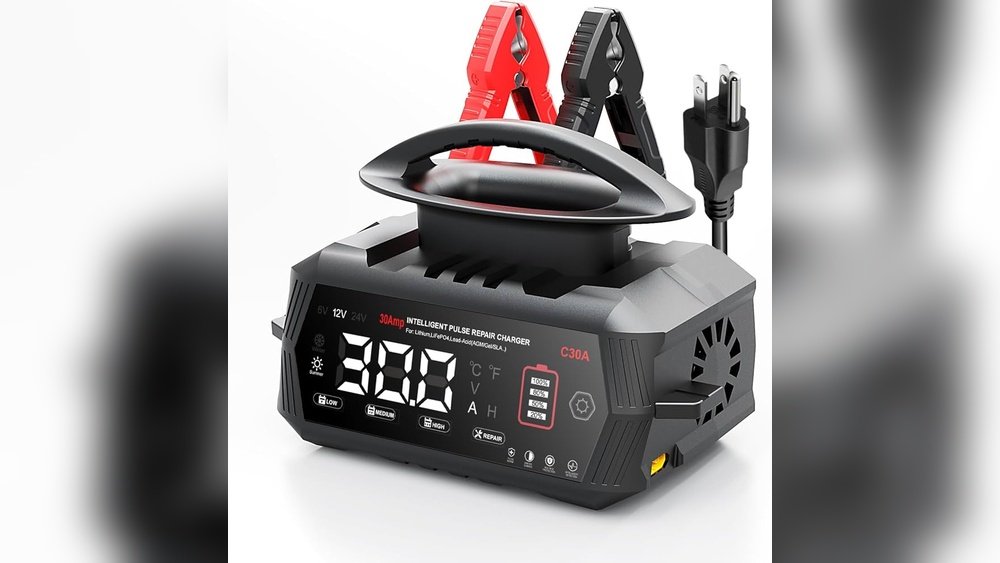
A portable car battery charger is a device that sends electrical current to a battery to recharge it. They are designed to be easy to use and transport, with alligator clips or built-in cables.
Main Functions
- Charge Mode – Restores energy to the battery over several hours.
- Jump Start Mode – Delivers a quick, high current to start an engine.
- Maintenance/Trickle Mode – Provides a small, steady current to keep the battery topped up.
Some chargers have only one mode, while others offer multiple. More advanced chargers detect battery type and size automatically, but older or cheaper models do not.
Key Features
- Amperage Settings: Car chargers often start at 6A, 10A, or higher. Motorcycle batteries usually need 1A to 2A for safe charging.
- Smart Charging: Newer chargers have microprocessors that adjust current automatically.
- Battery Type Selection: Some chargers let you pick lead-acid or lithium mode.
Real-world Example
You might have a portable car charger that offers 10A and 2A options. Using the 10A setting on a small motorcycle battery could cause overheating or permanent damage. The 2A setting is safer, but still may be a bit high for very small batteries.

Can You Use A Portable Car Battery Charger For Motorcycles?
The short answer is: sometimes, but only if you’re careful. Here’s what you need to consider before connecting your charger.
When It’s Safe
- The charger has a low-amp setting (2A or less)
- Your motorcycle battery is 12V (not 6V)
- The charger supports your battery’s chemistry (lead-acid, AGM, gel, or lithium)
- The charger has a “motorcycle” or “powersport” mode
When It’s Not Safe
- The charger only offers high-amp settings (6A or more)
- Your motorcycle uses a 6V battery
- The charger cannot handle lithium batteries, but your motorcycle uses one
- The charger lacks smart features or auto shut-off
Practical Advice
If your charger has a 2A mode, it’s usually safe for most 12V motorcycle batteries. Never use a 10A or higher setting. If you’re not sure, check the battery’s label for the recommended charge rate. Most motorcycle batteries print “Charge at 1A” or “Do not exceed 2A” on the case.
Tip: If your battery feels hot during charging, stop immediately. Heat is a sign of overcharging.
Step-by-step Guide: Charging A Motorcycle With A Portable Car Battery Charger
If you decide to use your car charger, follow these steps to stay safe and avoid damage.
1. Read The Manuals
Check both your motorcycle battery’s manual and the charger’s instructions. Look for warnings about compatible amperage, voltage, and battery type.
2. Set The Charger To The Lowest Amp Setting
For most motorcycles, use 1A or 2A. Never use “Jump Start” mode.
3. Check Battery Type
If your battery is lithium, make sure your charger has a lithium mode. If not, do not charge.
4. Disconnect The Battery
Remove the negative (–) cable first, then positive (+). This prevents short circuits.
5. Attach Charger Clamps
Connect the charger’s positive (red) clamp to the battery’s positive post, and the negative (black) clamp to the negative post.
6. Double-check Settings
Confirm the charger is set to 12V and the correct amp rate.
7. Plug In And Start Charging
Turn on the charger. Monitor the battery for heat or swelling.
8. Stop Charging At The Right Time
Most motorcycle batteries take 4–8 hours to charge at 2A. Smart chargers will shut off automatically. If not, check the voltage with a multimeter: 12.6V–13.2V means fully charged.
9. Disconnect And Reinstall The Battery
Remove the charger clamps. Reconnect the battery, positive first, then negative.
10. Test Start Your Motorcycle
Start your engine to check that the battery works.
Important: Never leave a standard car charger unattended on a motorcycle battery. Overcharging can cause leaks, swelling, or even explosions.
The Risks Of Using The Wrong Charger
Many riders think, “If it fits, it works.” This is not true for batteries. Using the wrong charger can cause several problems:
Overcharging
High amperage will “cook” a small battery. This leads to:
- Permanent capacity loss
- Internal damage
- Acid leaks (in lead-acid batteries)
- Swelling and fire risk (lithium batteries)
Undercharging
If the charger’s voltage is too low (for example, a 6V charger on a 12V battery), the battery will not charge fully. This causes:
- Shorter battery life
- Weak starting performance
Incorrect Chemistry Setting
Using a lead-acid charger on a lithium battery can destroy the battery quickly. Lithium batteries need special charging profiles.
Example
A rider in a motorcycle forum reported that using a cheap car charger on “fast charge” mode melted his battery and damaged his bike’s electronics. He thought “more amps = faster charging. ” In reality, more amps = more heat and more damage for small batteries.
Pros And Cons: Using A Car Battery Charger For Motorcycles
Let’s break down the advantages and disadvantages in detail.
| Pros | Cons |
|---|---|
| – Convenient if you already own a charger – No need for extra equipment – Works for 12V lead-acid batteries, if used carefully |
– Risk of overcharging – Not always compatible with small batteries – Can’t charge 6V or lithium batteries – May void battery warranty |
Motorcycle-specific Chargers Vs. Car Chargers
Motorcycle battery chargers are designed for lower amperage and smaller capacity. Here’s a side-by-side look:
| Feature | Motorcycle Charger | Car Charger |
|---|---|---|
| Amperage Range | 0.5A–2A | 2A–10A (or higher) |
| Battery Type Support | Lead-acid, AGM, Lithium | Mostly lead-acid, sometimes AGM |
| Smart Features | Yes (often) | Sometimes |
| Risk of Overcharging | Low | High (if not used properly) |
| Physical Size | Compact | Larger |
Non-obvious insight: Many motorcycle chargers double as maintainers, keeping your battery at full charge during storage. Car chargers rarely offer this feature.
Common Mistakes People Make
Even careful riders make errors when charging motorcycle batteries with car chargers. Here are mistakes to avoid:
1. Using High Amps
“Faster” is not better. High amps quickly damage small batteries.
2. Ignoring Battery Chemistry
Not all chargers support lithium. Always check.
3. Wrong Voltage
Accidentally setting the charger to 24V or 6V can destroy your battery.
4. Leaving The Charger Connected Too Long
Without auto shut-off, overcharging is likely.
5. Not Checking Battery Health First
Charging a severely damaged or old battery can be dangerous.
6. Not Disconnecting The Battery
Charging while the battery is in the motorcycle may affect electronics.
Practical tip: Use a voltmeter to check battery voltage before and after charging.

Smart Chargers And Battery Maintainers: Worth The Upgrade?
If you want to avoid mistakes, a smart charger or battery maintainer is a good investment. These devices:
- Detect battery type and condition automatically
- Adjust charging rate based on battery size
- Shut off when the battery is full
- Can maintain charge for months (perfect for seasonal storage)
Motorcycle-specific models are small, affordable, and safer for beginners. Brands like Battery Tender and Optimate are trusted by riders worldwide.
Non-obvious insight: Some smart chargers can recover “dead” batteries by using pulse charging to break up lead sulfate crystals.
What About Portable Jump Starters?
Many portable car chargers double as jump starters. They deliver a burst of high current to start an engine with a dead battery. Can you use one on a motorcycle?
Yes, but with caution:
- Make sure the jump starter is safe for small engines.
- Do not crank for more than 2–3 seconds.
- Check that the voltage matches (12V for most motorcycles).
- Remove the jump starter immediately after starting.
Jump starters are safe for emergencies but not for regular charging.
How To Choose The Right Charger For Your Motorcycle
If you decide to buy a charger for both your car and motorcycle, here’s what matters most:
1. Variable Amperage
Get a charger that offers both low (1A–2A) and high (6A–10A) settings.
2. Smart Features
Look for auto shut-off, battery type selection, and status indicators.
3. Battery Chemistry Support
If your motorcycle uses lithium, buy a charger with a lithium mode.
4. Physical Size
Portable chargers are easier to store on your bike.
5. Brand Reputation
Trusted brands like NOCO, Battery Tender, and CTEK are reliable.
6. Alligator Clips And Ring Terminals
Some chargers let you install a quick connector for easy charging.
Buyer mistake: Choosing the cheapest charger without smart features is risky. It can cost you more in battery replacements.
Real-world Experiences
Many motorcycle owners share their stories online. Here are two examples:
- Anna, a Honda owner: “I used my dad’s car charger on my Honda’s battery. It worked, but the battery died after a month. The mechanic said it was overcharged.”
- Mike, a Harley rider: “My smart car charger has a 2A mode and supports AGM. I use it for both my car and motorcycle with no problem. I just make sure to use the right settings.”
These stories show that attention to detail makes the difference between safe charging and expensive mistakes.
How To Extend Your Motorcycle Battery’s Life
Proper charging is only one part of battery care. Here are other tips:
1. Keep Terminals Clean
Dirty or corroded terminals weaken charging and starting.
2. Store Properly
If you don’t ride for weeks, use a maintainer to keep the battery charged.
3. Avoid Deep Discharge
Never let the battery go completely flat. It reduces battery lifespan.
4. Check Water Level (lead-acid Only)
For old-style batteries, top up with distilled water if needed.
5. Inspect Regularly
Look for cracks, leaks, or swelling.
Following these tips can double your battery’s lifespan.
Environmental And Safety Concerns
Batteries contain chemicals that can harm the environment. When charging:
- Avoid spills or leaks. Acid can damage your bike and the ground.
- Charge in a well-ventilated area. Charging batteries can produce hydrogen gas.
- Recycle old batteries. Never throw them in the trash.
For more on safe battery handling, see this guide from the U.S. Environmental Protection Agency.

Frequently Asked Questions
Can I Use A 10a Car Battery Charger On My Motorcycle Battery?
Using a 10A charger is not recommended for motorcycle batteries. The current is too high and can overheat or damage the battery. Always use the lowest amp setting (1A or 2A) available.
What Happens If I Overcharge My Motorcycle Battery?
Overcharging can cause the battery to swell, leak acid, or even explode. For lithium batteries, overcharging may cause a fire. Always monitor the charging process and use smart chargers with auto shut-off.
Is It Safe To Jump-start A Motorcycle With A Car Charger?
It is usually safe if both are 12V and you use the lowest setting. However, only use a jump starter for emergencies. Prolonged high-current charging is dangerous for small batteries.
Can I Charge A Lithium Motorcycle Battery With A Car Charger?
Only if the charger has a specific lithium mode. Standard car chargers can damage lithium batteries by using the wrong charging profile.
How Long Does It Take To Charge A Motorcycle Battery With A Car Charger?
At 1A–2A, most motorcycle batteries will fully charge in 4–8 hours. Charging at higher currents is not safe. Always check the battery’s instructions for the recommended charge time.
Using a portable car battery charger for your motorcycle can be safe, but only if you understand your battery, use the right settings, and watch for signs of trouble. When in doubt, a motorcycle-specific smart charger is the best investment for your bike’s health and your peace of mind.