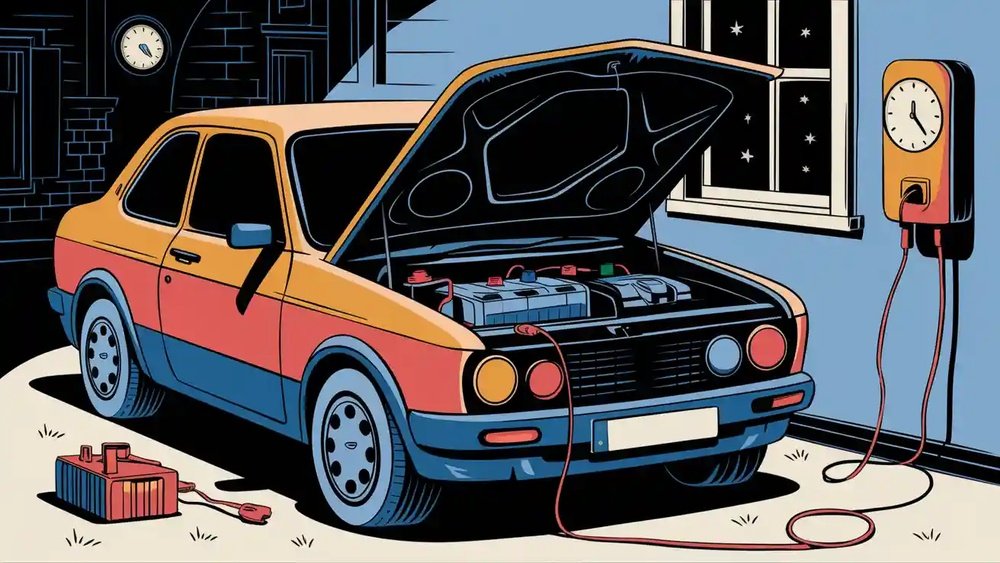
Leaving a car battery charger plugged in overnight is something many drivers wonder about, especially when their vehicle won’t start, or during cold weather. You might think it’s simple—just connect, wait, and you’re ready to go in the morning. But is it truly safe for your battery, your car, and your home?
Let’s explore everything you need to know, including the science of battery charging, types of chargers, real risks, and practical steps to avoid trouble.
Why People Leave Car Battery Chargers On Overnight
Car batteries sometimes die at the most inconvenient times. Maybe you left your headlights on, or your battery is simply old and weak. Overnight charging seems like a smart solution—let the battery gain power while you sleep, so the car is ready by morning.
Common reasons include:
- Deeply discharged batteries need several hours to recharge.
- Slow chargers (trickle chargers) work best over a long time.
- Cold weather reduces battery efficiency, making overnight charging helpful.
- Busy schedules—people want to set it and forget it.
But even if it’s convenient, safety should always come first. Understanding your charger and battery is critical to avoid damage or even danger.
Types Of Car Battery Chargers
Not all chargers are equal. The type of charger you use makes a big difference in whether overnight charging is safe.
Manual Chargers
These are the most basic chargers. You set the voltage and amperage, then connect the charger. Manual chargers do not turn off automatically. If you leave them on too long, the battery can overcharge, overheat, and even leak acid or explode in rare cases.
Automatic Chargers
Automatic (or smart) chargers are designed with safety in mind. They monitor the battery’s voltage and stop charging when it’s full. Some will switch to a maintenance mode, delivering a very small current to keep the battery at 100% without overcharging.
Trickle Chargers
A trickle charger supplies a low current (usually 1-2 amps) over a long time. These are safe for overnight use if they have an automatic shutoff or float mode, but unsafe if they’re manual and left unchecked.
Float Chargers
Float chargers are used mainly for long-term battery maintenance. They automatically adjust the current to keep the battery full, but not overcharged. These are the safest for overnight and long-term use.
Fast Chargers
Fast chargers deliver a high current, charging the battery quickly. These are not meant to be left on overnight, as they can overheat the battery and cause permanent damage.
Here’s a quick comparison of charger types and their overnight safety:
| Charger Type | Overnight Use | Risk Level | Automatic Shutoff |
|---|---|---|---|
| Manual Charger | No | High | No |
| Automatic Charger | Yes | Low | Yes |
| Trickle Charger | Sometimes | Medium | Depends |
| Float Charger | Yes | Very Low | Yes |
| Fast Charger | No | High | No |
Knowing your charger type is the first step to deciding if overnight charging is safe.
How Car Batteries Charge
Understanding how lead-acid car batteries work can help you see why overcharging is risky. Car batteries store and release electricity using a chemical reaction. When you charge the battery, you reverse this reaction and restore the battery’s energy.
The charging process happens in stages:
- Bulk Charge: High current brings the battery to about 80% full.
- Absorption Charge: Lower current charges the battery to near 100%.
- Float/Maintenance: Tiny current keeps the battery full without overcharging.
If you keep charging past 100%, the battery heats up. This can cause:
- Electrolyte loss (water in the battery turns to gas)
- Plate damage inside the battery
- Swelling, leaking, or even explosion
This is why automatic chargers with float modes are safest for overnight charging.
Risks Of Leaving A Charger Plugged In Overnight
While overnight charging can be safe with the right equipment, there are real risks if you use the wrong charger or ignore safety basics.
Overcharging
The most common risk is overcharging. This happens when the battery keeps getting current after it’s full. Overcharging leads to:
- Reduced battery life—the battery won’t last as long
- Heat buildup—can cause fires in rare cases
- Leaking acid—damages your car and is dangerous to touch
Fire Hazard
Although rare, a faulty charger or damaged battery can cause fire. This is more likely with old manual chargers or if the charger is left near flammable objects.
Gas Buildup
When a battery overcharges, it can release hydrogen gas. In a closed garage or tight space, this gas can build up and explode if there’s a spark.
Damage To Battery Or Car Electronics
Too much charging can damage the battery’s internal parts. In some cases, electrical surges from a bad charger can also affect the car’s sensitive electronics.
Charger Failure
Cheap or poorly made chargers might fail, causing overheating or short circuits. Always use a quality charger from a reputable brand.
Here’s a summary of the main risks:
| Risk | What Can Happen | Common Causes |
|---|---|---|
| Overcharging | Battery damage, leaks, swelling | Manual chargers, no shutoff |
| Fire | Vehicle or garage fire | Faulty chargers, poor ventilation |
| Gas Buildup | Explosion risk | Closed spaces, overcharging |
| Charger Failure | Short circuit, overheating | Cheap or damaged chargers |

When Is It Safe To Leave A Charger On Overnight?
It’s not always dangerous to leave a charger on overnight, but you must meet certain conditions.
Use The Right Charger
- Automatic chargers are generally safe overnight. They stop charging when the battery is full.
- Float chargers are designed for long-term use and can be left connected for days, weeks, or even months.
- Never use a manual charger overnight. These require you to monitor the battery and unplug when full.
Check The Battery Condition
- The battery should be in good health. Old, damaged, or leaking batteries are more likely to fail or cause problems.
- If your battery gets hot, smells strange, or leaks, stop charging immediately.
Proper Ventilation
Charging creates hydrogen gas, which needs to escape. Always charge in a well-ventilated area—never in a closed room or basement. This reduces the risk of explosion.
Quality Equipment
Use only chargers that are UL-listed or have another safety certification. Cheap chargers often lack important safety features.
Follow Manufacturer Instructions
Every charger is a little different. Read the manual and follow all instructions about charging times and safety.
Use The Correct Settings
Set the charger to the right voltage (usually 12V for cars) and current (check your battery’s label). Too much current can overheat the battery.
Monitor The First Few Times
When you use a new charger, check the battery every few hours the first few times you charge overnight. This helps you spot any problems before they become serious.
How Long Does It Take To Charge A Car Battery?
The time needed depends on your charger’s output and the battery’s size and state. Here’s a simple formula:
Battery Capacity (Ah) ÷ Charger Output (A) = Charging Time (hours)
For example, a 48Ah battery with a 4A charger:
48 ÷ 4 = 12 Hours
Most batteries need 8 to 16 hours for a full charge with a slow charger. Fast chargers can do it in 1-3 hours, but are not safe for overnight use.
Non-obvious tip: If your battery is only partly discharged, it will charge faster. A nearly dead battery always takes longer and may need a slower, gentler charge.
What If You Forget And Overcharge?
Mistakes happen. If you leave your charger on too long:
- Check the battery for heat, swelling, or leaks.
- Unplug immediately if you notice any problems.
- Let the battery cool down before handling.
- If you see liquid or powder, wear gloves and dispose of the battery safely.
- Replace damaged batteries—they are no longer safe.
Smart Chargers: The Best Choice For Overnight Charging
Smart chargers use microprocessors to monitor your battery. They can:
- Detect battery type and size
- Adjust current and voltage automatically
- Stop or switch to float mode when the battery is full
Some even have settings for cold weather or old batteries. This technology greatly reduces the risk of overcharging or fire.
Non-obvious insight: Smart chargers can sometimes even “revive” batteries that seem dead by using a special pulse mode. However, once a battery is deeply damaged, it’s better to replace it for safety.
Key Features To Look For In An Overnight Charger
Not all “automatic” chargers have the same features. When choosing a charger for overnight use, look for:
- Automatic shutoff: Charger stops when full.
- Float/maintenance mode: Keeps battery charged without overcharging.
- Reverse polarity protection: Prevents damage if you connect cables wrong.
- Short circuit and spark protection: Reduces fire risk.
- Temperature sensor: Adjusts charging if battery gets hot.
- UL or CE certification: Shows the charger meets safety standards.
Step-by-step: How To Safely Charge Your Car Battery Overnight
If you decide overnight charging is the right choice, follow these steps:
- Read the manual for both your charger and car battery.
- Check the battery terminals for corrosion. Clean if needed.
- Place the car in park (or neutral if manual) and turn off the ignition.
- Connect the positive cable (red) to the battery’s positive terminal.
- Connect the negative cable (black) to the battery’s negative terminal or a solid metal ground.
- Plug the charger into the power outlet.
- Set the charger to automatic or float mode.
- Check the area for good ventilation.
- Start charging and check for any problems in the first hour.
- Leave overnight if all is well. In the morning, unplug and disconnect the charger before starting your car.
Pro tip: Never smoke or use open flames near a charging battery. Even a small spark can ignite hydrogen gas.
Myths And Misconceptions About Overnight Charging
Many drivers believe myths about charging batteries. Let’s clear up some common ones:
- “Any charger is fine for overnight use.”
Only chargers with auto-shutoff or float mode are truly safe.
- “You can’t overcharge a modern battery.”
Even sealed “maintenance-free” batteries can be damaged by too much charging.
- “Trickle chargers never overcharge.”
Old trickle chargers can overcharge if left on too long—only float chargers are 100% safe for long-term use.
- “A fast charge is best for a dead battery.”
Fast charging can harm the battery; slow charging is safer for deep cycles.
Real-world Examples Of Problems
Case 1:
A driver used a manual charger overnight. By morning, the battery was swollen and leaking acid. The battery had to be replaced, and the acid damaged the car’s paint.
Case 2:
A cheap charger without safety certification overheated and started a small fire. Luckily, the garage was not attached to the house, but the car was badly damaged.
Case 3:
Someone left a sealed battery on a modern automatic charger for two days. The charger switched to float mode, and the battery was still in perfect condition.
These examples show the importance of the right equipment and following safety steps.
How To Tell If Your Battery Is Fully Charged
Many modern chargers have indicator lights or screens. If yours doesn’t, you can check the battery voltage with a simple multimeter:
- 12.6V to 12.8V: Fully charged
- 12.4V to 12.6V: About 75% charged
- 12.2V to 12.4V: About 50% charged
- Below 12.2V: Needs charging
If your battery never reaches 12. 6V, it may be old or damaged.
Battery Maintenance Tips For Longer Life
Keeping your battery healthy reduces the need for overnight charging:
- Drive regularly—short trips don’t charge your battery enough.
- Check terminals for corrosion every few months.
- Keep the battery clean and dry—moisture can cause current leaks.
- Test the battery every year, especially before winter.
- Replace old batteries (typically after 3-5 years).
Alternatives To Overnight Charging
If you find yourself needing to charge overnight often, consider:
- Replacing the battery—it may be nearing the end of its life.
- Checking for electrical drains—something in your car may be using power when off.
- Installing a solar maintainer—keeps the battery topped up without plugging in.
- Driving longer trips—the alternator charges the battery while you drive.
Non-obvious insight: Many car batteries are damaged not by cold weather itself, but by being undercharged during short city trips. Occasionally driving for 30 minutes or more helps keep batteries healthy.
When To Avoid Charging Overnight
You should never leave a charger on overnight if:
- You use a manual or old trickle charger.
- The battery is cracked, leaking, or smells of rotten eggs.
- The charger makes strange noises or gets hot.
- You cannot monitor the first few hours of charging.
Environmental And Cost Considerations
Overcharging wastes electricity and can pollute if you need to replace batteries more often. Smart chargers are more energy-efficient. Also, a new car battery can cost $80–$200, so damaging one with poor charging habits is expensive.
According to the Battery Council International, battery recycling and proper maintenance help reduce environmental impact. Always recycle old batteries at approved centers.
For more background on battery technology and safety standards, check out this detailed resource from the Wikipedia Car Battery page.
Frequently Asked Questions
What Happens If I Leave My Car Battery Charger On Too Long?
If you use a manual or old charger, the battery can overcharge. This leads to heat, leaks, swelling, and even fire in rare cases. Modern smart chargers usually prevent these problems by turning off or switching modes automatically.
Can I Leave A Trickle Charger On My Car Battery All Winter?
You can, but only if the trickle charger has an automatic shutoff or float mode. Old trickle chargers without these features can overcharge the battery after days or weeks. Float chargers are the safest for long-term use.
Is It Safe To Charge My Car Battery Inside My Garage?
Yes, if your garage is well ventilated. Charging produces hydrogen gas, which is explosive in high amounts. Never charge in a completely closed space, and keep the charger away from flammable objects.
How Do I Know If My Charger Is Automatic?
Check the charger’s manual or label. Automatic chargers will say “automatic,” “smart,” or mention features like “auto shutoff” or “float mode. ” If your charger has none of these, it’s likely manual.
Can A Car Battery Explode From Overnight Charging?
While rare, it is possible if the battery overcharges and hydrogen gas builds up. This is more likely with old or damaged batteries, manual chargers, or poor ventilation. Using an automatic charger and charging in a ventilated area greatly reduces the risk.
Charging your car battery overnight can be safe or dangerous depending on your equipment and habits. By using a modern automatic charger, checking your battery’s health, and following safety steps, you can avoid most risks and keep your car ready to go when you need it.