Choosing a car polisher depends on your experience level and the depth of paint correction you need. We compared units ranging from light-duty home tools to professional-grade gear. The main differences lie in their motor power, orbit size, and whether they’re corded or cordless for better movement.
Best overall: Chemical Guys TORQX Polisher, which balances a powerful 800W motor with an easy-to-control 9mm orbit, making it safe for beginners while still capable of professional-grade paint correction results. Best for beginners: AOBEN Dual Action Polisher, which features a user-friendly ergonomic design and a wide speed range that helps new users avoid common mistakes while learning to buff and wax. Best for heavy duty: DEWALT DWP849X Buffer, which provides a high-torque 12 amp motor and durable steel gears designed to power through the most demanding paint restoration tasks on large surfaces.
49% off Today's Exclusive Deals
Limited-time Exclusive Deals. Check current discount on Amazon.
Check Price on Amazon As an Amazon Associate I earn from qualifying purchases.This guide is for anyone looking to maintain their vehicle’s finish at home without the guesswork.
How We Picked
To find the right tools, we compared 48 different Amazon listings for car polishing machines. We focused on products that provided clear technical specifications, such as motor wattage, orbit size, and speed range settings. Products that lacked clear mechanical data or were missing essential usage details were excluded to ensure we only recommend tools with transparent performance capabilities.
All 7 products side by side — scroll sideways to see every column.
49% off Today's Exclusive Deals
Limited-time Exclusive Deals. Check current discount on Amazon.
Check Price on Amazon As an Amazon Associate I earn from qualifying purchases.| Top Pick | Runner-Up | Best for Heavy Duty | Best for Cordless Use | Best for High Power | Best for Professionals | ||
| Preview |  |  |  |  |  |  | 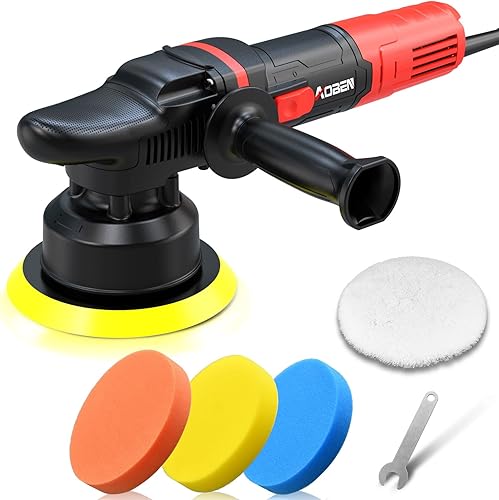 |
|---|---|---|---|---|---|---|---|
| Product | Chemical Guys TORQX Polisher | PORTER-CABLE 7424XP Polisher | DEWALT DWP849X Buffer | DEWALT 20V MAX XR | Milwaukee M18 Fuel Polisher | Rupes Big Foot Polisher | AOBEN Dual Action Polisher |
| Brand | Chemical Guys | PORTER-CABLE | DEWALT | DEWALT | Milwaukee | RUPES | AOBEN |
| Best for | Best Overall | Runner-Up | Best for Heavy Duty | Best for Cordless Use | Best for High Power | Best for Professionals | — |
| The listing says | BUF503 random orbital polisher Random orbital motion for safety | 4.5 Amp AC motor Variable speed 2,500-6,800 OPM | Ball-bearing construction with steel gears Rubber overmoulded gearcase | Efficient brushless motor 7-inch backing plate | Corded performance and runtime | Italian design and craftsmanship Soft start acceleration ramp | 120V 700W 6-inch dual action polisher Adjustable side and top handles |
| More information | Buy on Amazon | Buy on Amazon | Buy on Amazon | Buy on Amazon | Buy on Amazon | Buy on Amazon | Buy on Amazon |
1. Chemical Guys TORQX Polisher
Best for: Beginners and enthusiasts wanting professional results at home.
The Chemical Guys TORQX Polisher is built with a random orbital design that helps keep paint safe by minimizing the risk of holograms or burns. Its 800W motor provides consistent torque, while the 9mm orbit is optimized to balance defect removal with user control. The 4.7 lb weight is light enough for longer sessions, which is helpful if you’re detailing a full-sized truck or SUV.
49% off Today's Exclusive Deals
Limited-time Exclusive Deals. Check current discount on Amazon.
Check Price on Amazon As an Amazon Associate I earn from qualifying purchases.Use this tool if your primary goal is safe paint correction on a variety of surfaces. If you’re working on modern clear coats that require delicate handling, the random orbital motion provides the necessary safety buffer. However, if you’re a professional detailer looking for the highest possible speed for rapid heavy cutting, you might find the 9mm orbit slower than a dedicated long-throw machine.
Because this tool is designed for versatility, it works with various pads to apply compounds, glazes, and waxes. It’s a good fit for someone who wants one tool for multiple stages of paint care. Stick to the 9mm orbit for standard swirl and scratch removal; if you encounter deep oxidation, apply light pressure and let the 800W motor do the work to avoid overheating the paint.
Pros
- Random orbital motion prevents paint burns.
- Lightweight 4.7 lb frame reduces fatigue.
- Powerful 800W motor for consistent results.
Cons
- Not designed for ultra-rapid heavy cutting.
- Limited to 9mm orbit throw.
2. PORTER-CABLE 7424XP Polisher
Best for: Detailers who want a proven, reliable mechanical design.
This unit uses a 4.5 amp motor and offers a variable speed dial ranging from 2,500 to 6,800 OPM. The random orbit action is specifically designed to provide a swirl-free finish, making it a common choice for those who value consistent, predictable performance. It includes a 5-inch counter balance for use with 6-inch pads, which is a standard setup for most passenger vehicles.
The tool is strictly AC powered, which means you’ll need to manage a cord while working around the car. If you’re working in a tight garage, keep the cord draped over your shoulder to prevent it from dragging across freshly polished panels. This simple habit protects your finish from accidental scratches caused by friction.
It’s a solid choice for someone who prefers a machine with a long history of use in the detailing community. If you need a high-torque machine for aggressive paint correction, the 4.5 amp motor may require more time to achieve the same results as higher-wattage units. Use light pressure and let the random orbit action do the work; pressing too hard will stall the pad and increase your total project time.
Pros
- Reliable variable speed dial control.
- Proven random orbit, swirl-free action.
- Includes proprietary counter balance.
Cons
- AC power requires cord management.
- Lower amp rating than heavy-duty buffers.
3. DEWALT DWP849X Buffer
Best for: Heavy-duty paint correction and professional shop use.
The DEWALT DWP849X features a 12 amp motor and all ball-bearing construction, designed for long-term durability. The variable speed trigger and large dial allow you to adjust the RPM between 0 and 3,500 for precise control. A helpful safety feature is the no-volt release switch. This prevents the tool from starting automatically if it’s plugged in while the switch is already on. You must consciously reset the switch before power is delivered.
The unit also includes a replaceable wool ingestion shield. This prevents wool fibers from being sucked into the unit and blocking the tool, which extends the motor’s life. If you notice a loss in cooling air, check this shield immediately to prevent overheating.
Because this is a high-power rotary buffer, it isn’t the best choice for a total beginner who has never used a machine on automotive paint. It requires more skill to avoid burning through clear coats. If you’re new to detailing, start with a dual-action polisher to minimize the risk of surface damage. The gearcase features rubber overmoulding to provide a comfortable grip during long sessions. Pop-off brushes protect the armature from damage once they reach the end of their life, saving the motor from internal failure.
Pros
- High-torque 12 amp motor.
- Durable ball-bearing gear construction.
- Wool ingestion shield protects motor.
Cons
- Rotary action requires operator skill.
- Heavier than standard orbital polishers.
4. DEWALT 20V MAX* XR Cordless Polisher
Best for: Users who need cordless convenience for exterior detailing.
The DEWALT 20V MAX XR uses a brushless motor to maintain performance without the need for a power cord. It offers a speed range of 800 to 2200 RPM, which you can adjust via a dial or the trigger. The 7-inch backing plate is large enough to cover significant surface area, and the rubber gear case overmold helps improve your grip while working.
This tool is sold as a “tool-only” unit, meaning you must already own or purchase the battery and charger separately. It’s ideal for someone who already has other DEWALT 20V tools and wants to move freely around a vehicle. If you’re planning to polish multiple vehicles in one sitting, you’ll need extra batteries to avoid downtime.
Use the dial to set your maximum speed for a specific task, then use the trigger to feather that speed for delicate curves or edges. If you find the tool difficult to maneuver, switch from the side handle to the front grip to change your leverage. The rubber overmold is there to protect your paint; if you feel the gear case touch the surface, you’re likely applying too much pressure.
Pros
- Brushless motor for efficient runtime.
- No cord allows total movement.
- Variable speed trigger and dial.
Cons
- Battery and charger sold separately.
- Requires spare batteries for long jobs.
5. Milwaukee 2738-20 M18 18-Volt Fuel Lithium-Ion Brushless Cordless 7 inch
Best for: Professionals needing corded-level power in a cordless package.
The Milwaukee M18 Fuel Polisher is designed to deliver power that matches corded units, allowing you to tackle demanding tasks without being tethered to an outlet. It uses a brushless motor to manage energy efficiently, which helps maintain high performance during long sessions. This is a 7-inch rotary polisher built for users who are already invested in the M18 battery system.
Like the other cordless options, this is a tool-only purchase that requires separate batteries. It is designed for professional mobile detailers who need to work on location where power access might be limited.
Pros
- Corded-level performance in cordless tool.
- Brushless motor for high efficiency.
- Compatible with existing M18 batteries.
Cons
- Tool-only, batteries sold separately.
- Premium investment for casual users.
6. Rupes LHR21ES Big Foot Random Orbital Polisher
Best for: Professional detailers prioritizing high-end Italian craftsmanship.
The Rupes Big Foot Polisher features a 500W motor and is known for its specialized design. It includes a soft-start function that prevents the machine from jumping when you turn it on, which helps keep your polishing compound from flinging off the pad. The anti-spinning feature is another highlight, as it limits high-speed rotation to prevent accidental scratches.
If you’re working on delicate clear coats, rely on the anti-spinning feature to maintain control. This prevents the pad from reaching dangerous speeds that lead to heat buildup or unintended paint damage.
This machine is engineered for precision and is a favorite among those who perform high-end, detailed paint correction. Because it’s a specialized tool with a 500W motor, it may not be as aggressive as the heavy-duty corded buffers on this list. It’s best suited for someone who wants a refined, smooth-operating machine for final finishing stages.
If you need to remove deep, heavy oxidation, choose a more aggressive tool. If your goal is a swirl-free, mirror-like finish, the Big Foot is the correct choice.
Pros
- Soft-start prevents product dispersion.
- Anti-spinning feature protects paint.
- High-quality Italian engineering.
Cons
- Lower wattage than some alternatives.
- Best for finishing, not heavy cutting.
7. AOBEN Dual Action Polisher
Best for: First-time buyers who want a complete starter kit.
The AOBEN Dual Action Polisher is a 700W, 6-inch unit that offers six variable speeds from 1,000 to 4,500 RPM. It comes with a variety of pads, including foam and wool, making it a “ready-to-go” package for someone just starting out. The design includes both a side handle and a top handle, which helps reduce fatigue if you aren’t used to holding a buffer for long periods.
Use the lower speeds (1-3) for waxing and buffing. Switch to medium settings for cleaning and polishing, or move to high speed to remove oxidation and paint defects. If the machine stops during use, you have applied excessive pressure. Don’t force it; simply restart the unit and select a higher speed setting to regain power.
The kit includes 6.5-inch foam pads. These are sized specifically to ensure the hard edge of the 6-inch backing plate never contacts your paint, preventing accidental scratches. The plastic head shell provides heat insulation during high-strength operation, protecting your hands.
If you’re a professional, you might find the build less durable than high-end industrial options. However, for occasional maintenance on cars, boats, or furniture, it offers an accessible entry point.
Pros
- Includes a full starter kit.
- Multiple variable speed settings allow for precise control over the polishing process.
- Ergonomic handles reduce fatigue.
Cons
- May stop under excessive pressure.
- Build quality is for occasional use.
How to Choose the Best Car Polishing Machine
Which type of polisher is safest for my paint?
A dual-action (DA) polisher is generally the safest choice for beginners because it uses a random orbital motion to prevent the heat buildup that causes paint burns. Most manufacturers follow ISO 19432 guidelines for handheld power tool safety, which helps ensure the tools are built to minimize vibration and user risk. Tools like the Chemical Guys TORQX or AOBEN Dual Action are designed with this random motion. They’re much less likely to cause permanent damage to your clear coat compared to a rotary buffer, which requires more skill to operate safely.
Is cordless or corded better for me?
Cordless polishers like the Milwaukee M18 Fuel Polisher or DEWALT 20V MAX XR provide freedom of movement, allowing you to reach every panel without dragging a cord across your paint. However, they require compatible batteries and chargers, and you must manage your runtime during long jobs. Corded polishers, such as the DEWALT DWP849X or PORTER-CABLE 7424XP, provide unlimited power and are often lighter because they lack heavy battery packs.
What should I check before buying?
Before ordering, verify that the backing plate size matches the pads you intend to use. Most polishers include a specific backing plate that dictates the size of the foam pads you need to purchase. Also, confirm whether the model is sold as a “tool-only” version or a full kit. If you buy a tool-only model, you’ll need to purchase the battery and charger separately to use it. Finally, look at the weight of the unit, as a heavy tool can lead to fatigue if you plan to detail your entire vehicle.
Frequently Asked Questions
What maintenance does a car polisher require after use?
Clean your buffing pad with warm water and mild soap after every use to remove wax and compound. Inspect the backing plate for debris to prevent scratches during future sessions. Keep ventilation slots clear of dust to prevent motor overheating.
Is the simplest polisher on this list enough for my needs?
The AOBEN Dual Action Polisher is suitable for most home users performing basic waxing, polishing, and light paint correction. It includes a variety of pads and a wide speed range for different materials. It lacks the industrial-grade motor components found in the DEWALT DWP849X.
What is the biggest mistake a beginner makes?
Avoid applying heavy pressure while the machine is running to prevent clear coat damage. Many models, like the AOBEN Dual Action Polisher, are designed to stop under excessive pressure to protect your paint. Start at a slow speed and let the tool’s motion do the work.
Do I need to buy extra accessories separately?
Kits like the Chemical Guys TORQX Polisher and AOBEN Dual Action Polisher include the necessary pads to get started immediately. Professional-grade tools like the Milwaukee M18 Fuel Polisher or DEWALT 20V MAX XR are often sold as tool-only. Always check the listing to confirm what is included in the box.
Closing
The Chemical Guys TORQX Polisher stands out as the best overall choice for most users, offering a perfect balance of safety, power, and ease of use. Its random orbital design minimizes the risk of burns or holograms, making it a reliable pick for beginners.
If you need a machine that can handle professional-grade, heavy-duty tasks, the DEWALT DWP849X Buffer is the top performer. Its 12-amp motor and all ball-bearing construction provide the durability required for demanding applications.
To get started, check your vehicle’s paint condition. Use low speeds for waxing and buffing, and reserve high speeds for removing paint defects or oxidation. If your machine stops under pressure, you’re likely using too much force; simply restart and select a higher speed setting. Always match your pad type to the specific task, whether you’re polishing, compounding, or finishing.