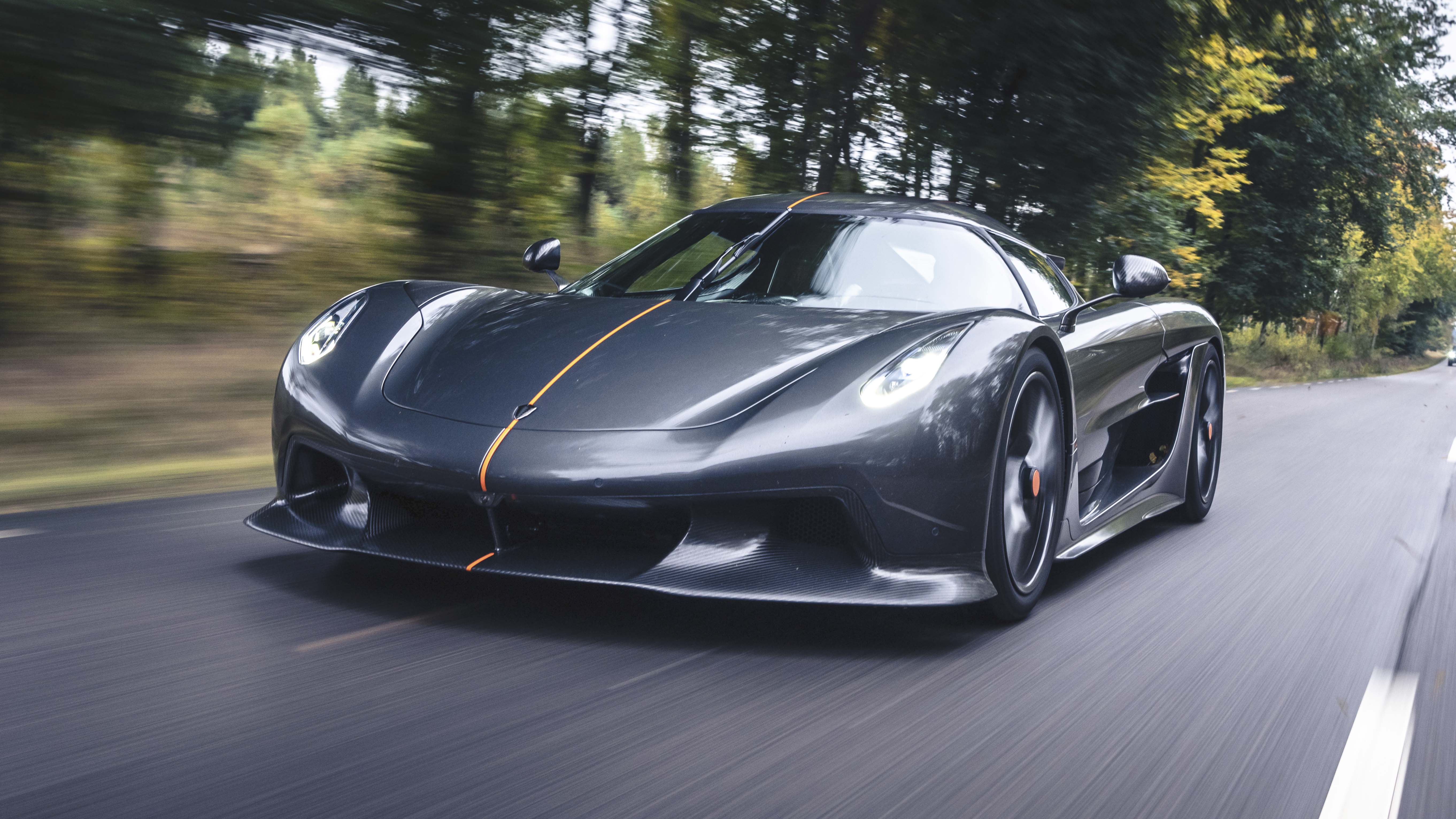
The Koenigsegg Jesko Absolut has a projected top speed of more than 330 mph, or about 531 km/h.
The Koenigsegg Jesko Absolut top speed is one of the most debated figures in modern car history. It is not yet a fully verified public record, but the car’s power, low drag, and advanced transmission make its 330-plus-mph claim technically credible. This guide explains what the number means, how Koenigsegg calculated it, and why real-world testing is so difficult.

49% off Today's Exclusive Deals
Limited-time Exclusive Deals. Check current discount on Amazon.
Check Price on Amazon As an Amazon Associate I earn from qualifying purchases.Koenigsegg Jesko Absolut top speed at a glance
The Koenigsegg Jesko Absolut is designed to be the fastest version of the Jesko family. Koenigsegg has stated that it could exceed 330 mph, equal to roughly 531 km/h, under ideal conditions.
That figure is a calculated target, not a confirmed production-car record. The car must still complete a timed, independently verified run before the Koenigsegg Jesko Absolut top speed becomes an official record.
Key facts include:
49% off Today's Exclusive Deals
Limited-time Exclusive Deals. Check current discount on Amazon.
Check Price on Amazon As an Amazon Associate I earn from qualifying purchases.• Projected top speed: More than 330 mph
• Metric equivalent: More than 531 km/h
• Engine: 5.0-liter twin-turbocharged V8
• Maximum power: Up to 1,603 horsepower on E85 fuel
49% off Today's Exclusive Deals
Limited-time Exclusive Deals. Check current discount on Amazon.
Check Price on Amazon As an Amazon Associate I earn from qualifying purchases.• Maximum torque: 1,106 lb-ft
• Transmission: Nine-speed Light Speed Transmission
• Claimed drag coefficient: 0.278
• Main design goal: Maximum speed with lower aerodynamic drag
The number is best understood as an engineering estimate. It reflects computer simulations, power output, gearing, tire limits, and aerodynamic data. It should not be treated as a measured result until the car completes a public high-speed test.
Source: topgear.com
Why the Koenigsegg Jesko Absolut can exceed 330 mph
High speed is not created by horsepower alone. A car needs enough power to overcome air resistance, rolling resistance, drivetrain losses, and small changes in road surface.
Air resistance rises sharply as speed increases. At 330 mph, the car faces far more drag than it would at 200 mph. This is why the Jesko Absolut looks so different from a race-focused hypercar. Its body is shaped to cut through the air rather than create large amounts of downforce.
The Koenigsegg Jesko Absolut top speed estimate comes from the balance of several key factors:
• High engine power: The V8 produces enough power to keep accelerating at extreme speed.
• Low aerodynamic drag: The body reduces the energy lost to the air.
• Tall gearing: The final gear allows the car to use its power at very high speeds.
• Stable body design: The long tail helps control airflow and reduce lift.
• Low weight: Less mass helps the car accelerate more easily.
At normal road speeds, these details may seem small. At more than 300 mph, they become the difference between gaining speed and reaching an aerodynamic wall.
The role of engine power
The Jesko Absolut uses a 5.0-liter twin-turbo V8. On regular gasoline, output is lower, but on E85 fuel, Koenigsegg quotes up to 1,603 horsepower.
E85 can support higher boost pressure because it has strong resistance to knock. It also helps cool the intake charge. However, fuel quality, temperature, and engine settings all affect the final result.
The engine produces up to 1,106 lb-ft of torque. That force is sent through Koenigsegg’s Light Speed Transmission, which can shift very quickly without using a traditional heavy dual-clutch design.
The role of aerodynamics
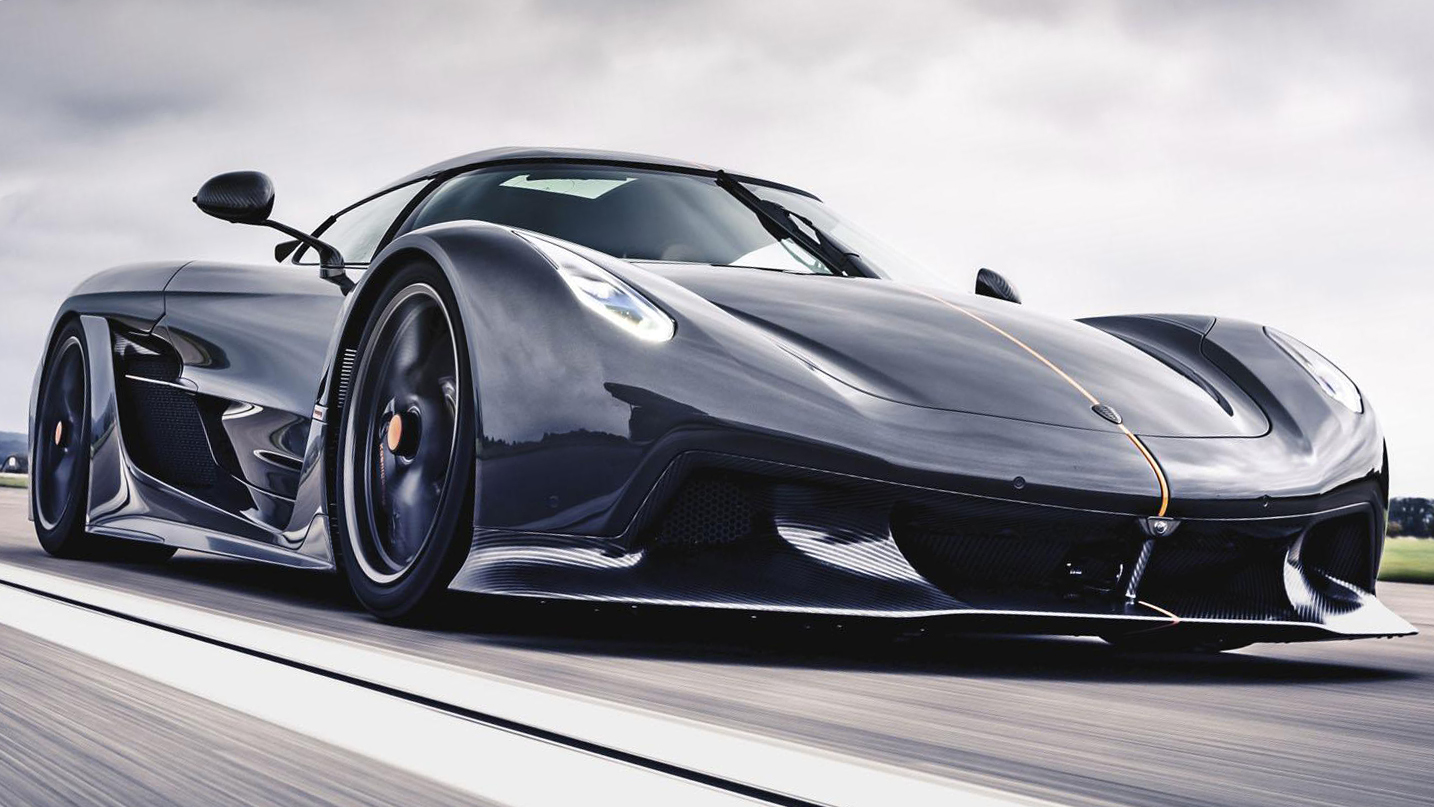
The Jesko Absolut has a claimed drag coefficient of 0.278. That is a very low figure for a high-performance car, especially one with enough cooling hardware to support a powerful turbocharged engine.
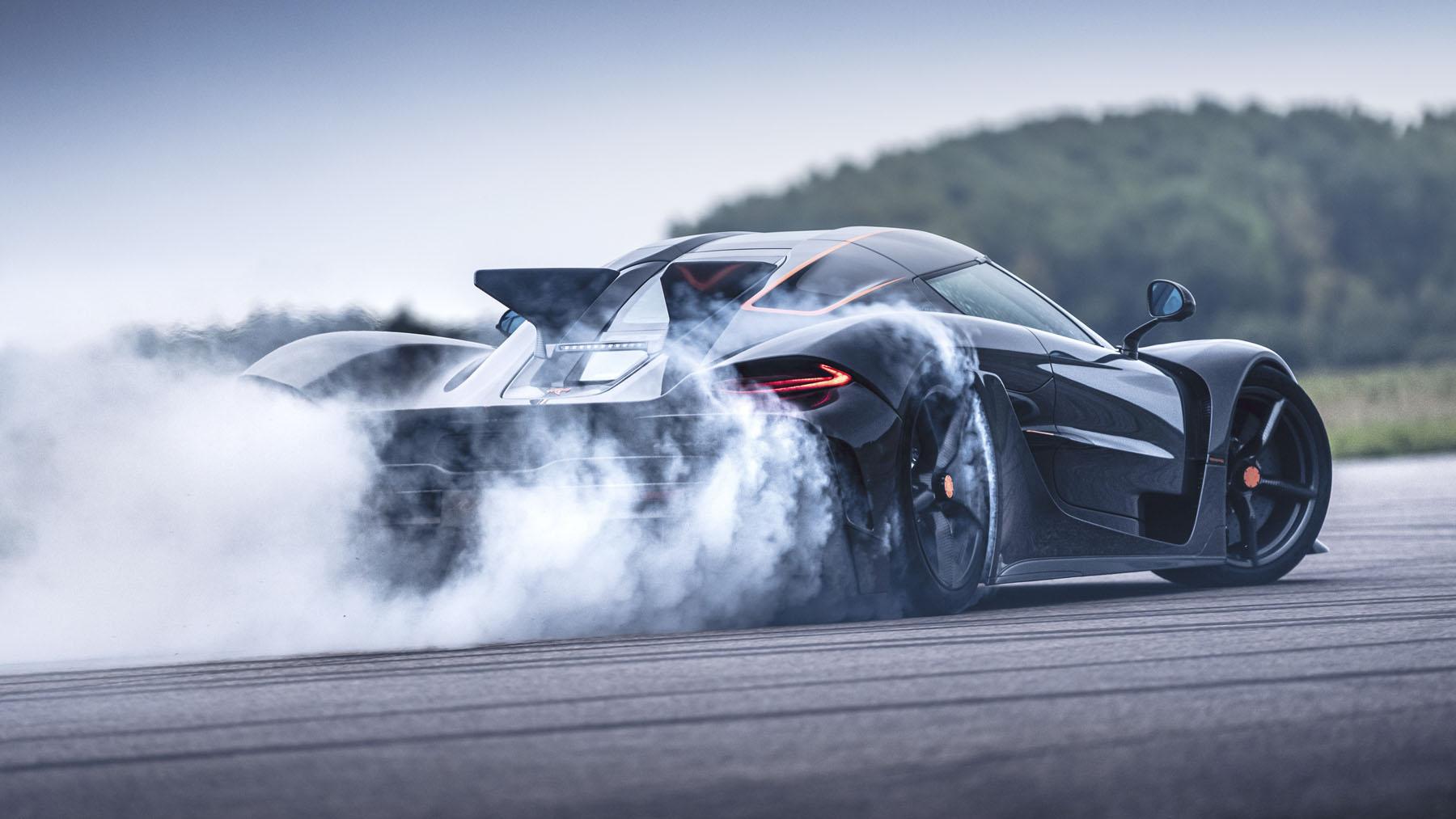
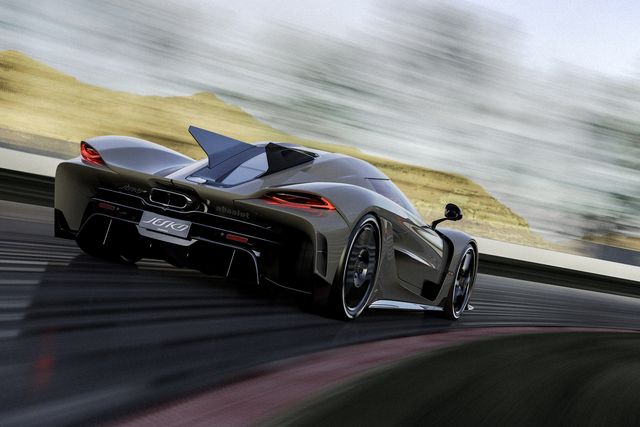
The car does not use the huge rear wing seen on the regular Jesko Attack. Instead, it has two long rear fins. These fins help the car stay stable while creating less drag.
This design shows the core trade-off in the Koenigsegg Jesko Absolut top speed project. The Jesko Attack is built for cornering and downforce. The Absolut is built to move through the air with as little resistance as possible.

Source: motor1.com
Koenigsegg Jesko Absolut specifications that matter
A specification sheet cannot tell the whole story, but it helps explain why the Jesko Absolut has such a high projected top speed.
| Feature | Koenigsegg Jesko Absolut |
|---|---|
| Engine | 5.0-liter twin-turbocharged V8 |
| Power on E85 | Up to 1,603 hp |
| Torque | Up to 1,106 lb-ft |
| Transmission | Nine-speed Light Speed Transmission |
| Claimed drag coefficient | 0.278 |
| Body style | Low-drag hypercar |
| Projected top speed | More than 330 mph |
| Drive layout | Rear-wheel drive |
The Jesko Absolut also uses an active rear steering system. This can improve stability and response, although the car’s high-speed setup focuses more on straight-line control than tight-corner agility.
Its carbon-fiber structure keeps weight low and stiffness high. Exact curb weight can vary with equipment, fluids, and test setup. That matters because a small weight change can affect acceleration, but drag remains the biggest challenge at the top end.
Light Speed Transmission
The Light Speed Transmission is one of the car’s most unusual parts. It uses multiple clutches to select the needed gear quickly. The system can skip gears instead of shifting through each ratio one by one.
For example, the car may move from a lower gear to a much higher gear when the software sees that the intermediate gears are not useful. This saves time and keeps the engine closer to its ideal power range.
For the Koenigsegg Jesko Absolut top speed, the highest gear ratio is especially important. If the gearing is too short, the engine reaches its limit before the car reaches maximum speed. If it is too tall, the engine may not have enough force to continue accelerating.
E85 fuel and operating conditions
The advertised 1,603 horsepower figure depends on E85 fuel. Many road cars can use gasoline, but the engine will not produce the same maximum output.
A real high-speed run also depends on:
• Fuel temperature and quality
• Tire temperature and condition
• Wind direction and speed
• Track length and surface
• Air density
• Engine temperature
• Vehicle setup
This is why a projected top speed cannot be copied from a simulator and treated as a guaranteed road result.
Source: topgear.com
How the Koenigsegg Jesko Absolut top speed is calculated
Engineers estimate top speed by comparing available power with the power required to overcome resistance.
The main force is aerodynamic drag. A simplified drag equation uses air density, drag coefficient, frontal area, and speed. The important point is that speed is raised to the second power in the drag force equation. As a result, the power needed to overcome drag rises even faster.
A simple version of the relationship is:
Power needed for drag = 0.5 × air density × drag coefficient × frontal area × speed³
This formula is not enough to predict a real-world result by itself. Engineers must also include rolling resistance, drivetrain losses, tire deformation, altitude, wind, and surface conditions.
The Koenigsegg Jesko Absolut top speed estimate likely comes from a combination of:
- Computer-aided aerodynamic modeling
- Wind-tunnel development
- Engine dynamometer testing
- Gear and tire calculations
- Stability analysis
- Simulation at different temperatures and air densities
A low drag coefficient helps, but it does not tell us the total drag force. Frontal area also matters. Two cars can have the same drag coefficient but different real-world drag if one has a larger front profile.
Why speed claims can differ
Automakers may quote a projected maximum speed based on ideal conditions. Independent testers may measure a lower speed because of wind, track limits, tire restrictions, or a different fuel load.
There is also a difference between:
• Theoretical top speed: A calculated estimate
• Manufacturer target: A claimed engineering goal
• Test speed: A speed reached during testing
• Official record: A measured and verified result under accepted rules
The Koenigsegg Jesko Absolut top speed remains in the projected category until a verified run confirms it.
Source: youtube.com
Is 330 mph realistic for a production car?
A 330-mph production car is realistic in theory, but it is extremely difficult in practice. The car must produce enough power while remaining stable, reliable, and safe at a speed where small disturbances can have serious effects.
The Bugatti Chiron Super Sport 300+ showed that a specially prepared car could pass 300 mph. The run reached about 304.773 mph, or 490.484 km/h, in a pre-production vehicle. That test demonstrated the scale of the challenge, but it also showed why record attempts need careful rules and controlled conditions.
The Koenigsegg Jesko Absolut top speed target is higher still. The car must gain more than 25 mph beyond the 300-mph mark. That may sound like a small increase, but the extra aerodynamic load is substantial.
The tire problem
Tires are one of the biggest limits. At extreme speed, a tire experiences enormous centrifugal force. Heat, balance, construction, and surface condition all become critical.
A high-speed tire must handle:
• Very high rotational speed
• Heat buildup
• Heavy vertical loads
• Small road imperfections
• Sudden changes in grip
A tire failure at 330 mph would be catastrophic. This is why manufacturers work closely with tire specialists and use strict inspection procedures before testing.
The track problem
Very few roads or test tracks are long and smooth enough for a 330-mph attempt. The car needs room to accelerate, reach its maximum speed, and slow down safely.
A record run also needs:
• A closed course
• Medical and rescue teams
• Timing equipment
• Wind monitoring
• Tire checks
• Surface inspections
• Multiple test runs
For safety, readers should never try to test the Koenigsegg Jesko Absolut top speed on a public road. Even professional teams need a controlled facility and a carefully planned test program.
Source: topgear.com
Koenigsegg Jesko Absolut versus other hypercars
The Jesko Absolut sits in a small group of ultra-high-speed hypercars. Its closest rivals include the Bugatti Chiron Super Sport 300+, the Hennessey Venom F5, and the Rimac Nevera.
Each car takes a different route to extreme performance.
• Bugatti Chiron Super Sport 300+: Uses a quad-turbo W16 and has demonstrated a speed above 300 mph in a special test configuration.
• Hennessey Venom F5: Uses a lightweight carbon-fiber body and a twin-turbo V8, with a target above 300 mph.
• Rimac Nevera: Uses electric motors and instant torque, with a lower top speed but very strong acceleration.
• Koenigsegg Jesko Absolut: Uses a twin-turbo V8, low-drag bodywork, and tall gearing to target more than 330 mph.
The Koenigsegg Jesko Absolut top speed is therefore part of a larger contest between combustion power, electric torque, aerodynamics, and tire technology.
Why the fastest car is not always the best car
Maximum speed is only one measure of performance. A car that reaches 330 mph may not be the quickest around a track. A car with electric all-wheel drive may accelerate faster from a stop. Another car may offer better braking or cornering.
The regular Jesko Attack is a good example. It produces more downforce and is better suited to circuits. The Absolut gives up some cornering focus to reduce drag.
That difference matters for buyers and fans. The right hypercar depends on what the driver values:
• Top-speed performance
• Track handling
• Acceleration
• Comfort
• Technology
• Sound and engine character

Source: robbreport.com
What it feels like to approach 330 mph
I cannot honestly claim to have driven or tested a Koenigsegg Jesko Absolut. No responsible writer should invent a personal test story for a car that has not completed a widely verified public top-speed run.
However, high-speed testing reports from professional drivers and engineers show a clear pattern. At extreme speed, the experience is less about drama and more about control. The car must feel calm, steady, and predictable.
That is an important lesson for enthusiasts. A loud engine and a large horsepower number do not prove that a car is ready for maximum speed. Stability, tire control, cooling, braking, and driver confidence matter just as much.
If you ever attend a professional high-speed event, watch the preparation rather than only the final number. The careful checks often reveal more about engineering quality than the speed display itself.
Mistakes to avoid when reading top-speed claims
Many online discussions mix different types of performance data. Avoid these common errors:
• Treating a simulation as a verified record
• Comparing a modified car with a standard production car
• Ignoring one-way versus two-way speed runs
• Forgetting that fuel and tire setups can change results
• Comparing speedometer readings with GPS measurements
• Assuming a top-speed figure applies to every customer car
A careful reader should always ask how the speed was measured, where it was measured, and whether the car matched the production specification.
Source: roadandtrack.com
The limits of the Koenigsegg Jesko Absolut top speed
The Koenigsegg Jesko Absolut top speed is limited by more than engine power. It depends on the weakest part of the entire system.
Aerodynamic lift is one concern. As speed rises, airflow can create forces that make the car lighter or less stable. The body must keep the car planted without adding too much drag.
Cooling is another challenge. The engine, turbochargers, transmission, brakes, and tires all generate heat. A car may have enough power for a short burst but still need careful thermal control for a complete run.
The car also faces legal and practical limits. A top-speed attempt cannot be safely repeated on normal highways. Even on a closed course, track length and weather may prevent a full-speed run.
Why the official number may change
Koenigsegg may eventually publish a measured top speed. That number could be higher or lower than the original projection.
Possible reasons include:
• A different tire specification
• A revised software tune
• A change in fuel type
• A different air temperature
• A tailwind or headwind
• A production specification change
• A decision to limit the car for safety
Until a properly documented test takes place, “more than 330 mph” remains the most accurate way to describe the claim.

Source: youtube.com
Frequently asked questions about the Koenigsegg Jesko Absolut top speed
What is the Koenigsegg Jesko Absolut top speed?
Koenigsegg has projected a top speed of more than 330 mph, or approximately 531 km/h. This is an estimated capability, not yet a universally accepted official production-car record.
Has the Koenigsegg Jesko Absolut reached 330 mph?
A publicly verified production-car run at 330 mph has not been confirmed. The figure comes from engineering calculations and manufacturer claims based on the car’s power and aerodynamic design.
How much horsepower does the Jesko Absolut produce?
The Jesko Absolut can produce up to 1,603 horsepower when running on E85 fuel. Output is lower with standard gasoline.
What engine does the Jesko Absolut use?
It uses a 5.0-liter twin-turbocharged V8 engine. The engine produces up to 1,106 lb-ft of torque and works with Koenigsegg’s nine-speed Light Speed Transmission.
Why is the Jesko Absolut different from the Jesko Attack?
The Absolut is built for maximum straight-line speed and low drag. The Jesko Attack uses larger aerodynamic components to create more downforce for track driving and cornering.
Is the Jesko Absolut faster than the Bugatti Chiron Super Sport 300+?
The Jesko Absolut has a higher projected top speed, while the Bugatti Chiron Super Sport 300+ has completed a documented run above 300 mph in a special test configuration. A direct comparison should wait until the Jesko Absolut completes a verified top-speed test.
Conclusion
The Koenigsegg Jesko Absolut top speed is projected to exceed 330 mph, making it one of the most ambitious performance targets ever set for a road-legal hypercar. Its twin-turbo V8, 1,603-horsepower output, low-drag body, tall gearing, and advanced transmission all support that goal.
Still, a projected number is not the same as a verified record. The final result will depend on tires, weather, track length, fuel, software, and safety conditions. For now, the Jesko Absolut remains a remarkable example of what modern automotive engineering may achieve.
Follow verified test results, compare measured data carefully, and share your view on whether the Jesko Absolut can truly pass 330 mph.