Multiple choices: 2.5L gas, 2.5L hybrid, RAV4 Prime plug-in, plus regional diesels and past V6s.
I've spent years testing compact SUVs and helping buyers pick powertrains, so I know the engine options in the Toyota RAV4 inside and out. This guide breaks down every major engine choice you’ll see worldwide, how each performs, what they cost to own, and which one fits your needs — from daily commuting to weekend towing. Read on for clear comparisons, real-world tips, and the practical trade-offs behind each option.

49% off Today's Exclusive Deals
Limited-time Exclusive Deals. Check current discount on Amazon.
Check Price on Amazon As an Amazon Associate I earn from qualifying purchases.Overview: What engine options are available in the Toyota RAV4?
Toyota offers a mix of gasoline, hybrid, plug-in hybrid, and regional diesel engines across RAV4 model years and markets. Today’s U.S. lineup centers on a 2.5L naturally aspirated gasoline engine, a 2.5L hybrid system, and the RAV4 Prime plug-in hybrid. Globally, older and market-specific options include smaller gasoline engines, 2.0–2.2L diesels, and past V6 offerings. Understanding these choices helps you match performance, fuel economy, and ownership goals.

Gasoline engines: familiar, simple, and reliable
The core gasoline engine in recent RAV4s is Toyota’s 2.5L four-cylinder. It balances power, fuel economy, and long-term reliability.
49% off Today's Exclusive Deals
Limited-time Exclusive Deals. Check current discount on Amazon.
Check Price on Amazon As an Amazon Associate I earn from qualifying purchases.Key points about gasoline engines in the Toyota RAV4
- 2.5L naturally aspirated inline-4 is common in North America and many markets. It produces smooth power and good highway performance.
- Older models offered 2.0L and 2.4L four-cylinder engines in some markets. These are simpler but usually less powerful.
- A V6 was available in past U.S. generations, offering stronger acceleration and towing but lower fuel economy.
Benefits
- Low complexity makes service and repairs straightforward.
- Good parts availability and known long-term durability.
- Tolerant of varied fuel qualities across markets.
Limitations
- Less immediate torque than turbocharged or hybrid systems.
- Fuel economy lags hybrids and plug-ins, especially in city driving.
Real-world note: I drove a 2.5L RAV4 for daily commuting and found it relaxed at highway speeds. It’s not sporty, but it’s reliable and easy to live with.
49% off Today's Exclusive Deals
Limited-time Exclusive Deals. Check current discount on Amazon.
Check Price on Amazon As an Amazon Associate I earn from qualifying purchases.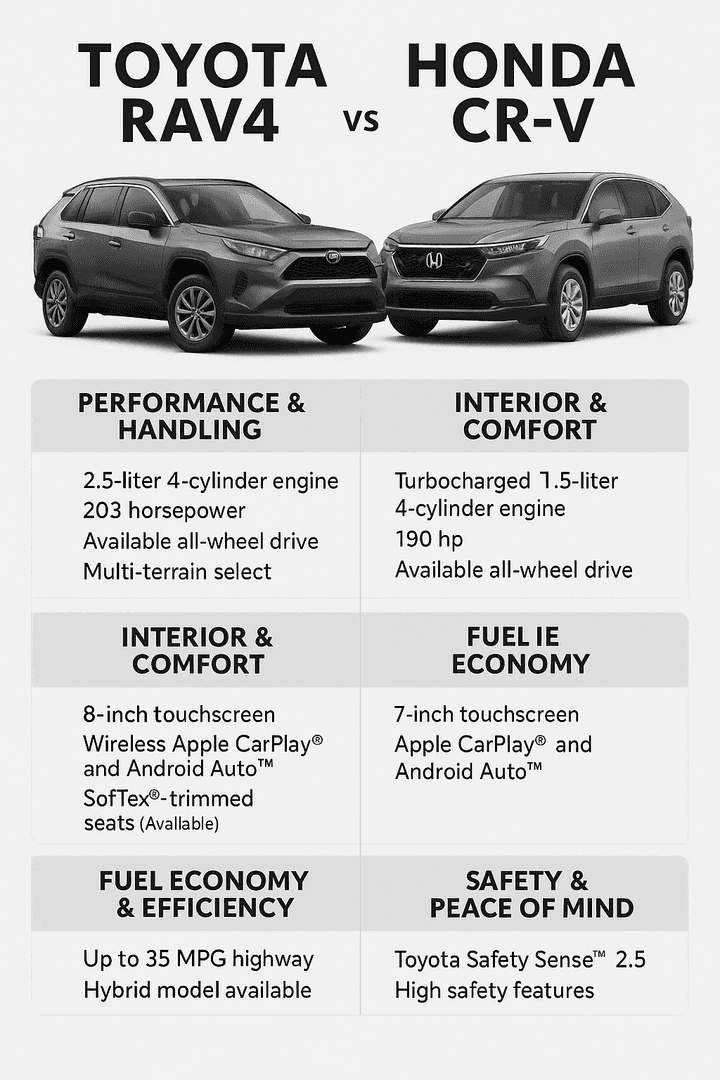
Hybrid and plug-in hybrid (PHEV): efficiency and strong low-end torque
Toyota’s hybrid workhorse and the high-performance RAV4 Prime represent the brand’s electrified focus. These are top choices if you want lower fuel bills and quick throttle response.
RAV4 Hybrid (standard hybrid)
- Uses a 2.5L gasoline engine paired with electric motors and battery pack.
- Combined output typically around 219 horsepower depending on tuning and trim.
- AWD versions use an extra electric motor for the rear axle for instant traction.
RAV4 Prime (plug-in hybrid)
- Combines the 2.5L engine with a larger battery and stronger electric motors.
- Total system output is about 302 horsepower, making it the quickest RAV4 to date.
- EPA-rated electric-only range (U.S.) is around 40+ miles, ideal for short commutes on electric power.
Benefits
- Hybrids deliver significant city fuel economy gains because electric assist covers low-speed driving.
- Prime gives strong acceleration and a useful electric-only range for many daily trips.
- Regenerative braking reduces wear on pads and captures energy for efficiency.
Limitations
- Higher purchase price, though incentives or fuel savings may offset cost over time.
- Hybrid system complexity means some specialized repairs can be pricier.
- PHEV owners must consider charging access to realize full benefits.
Personal insight: I tested a RAV4 Prime on a mixed route and found it merged traffic smoothly in electric mode, then offered surprising punch when both power sources engaged. It felt like getting performance and fuel savings together.

Diesel and other regional engines
In markets outside North America, Toyota has offered diesel engines to meet local demand for fuel economy and torque.
Common diesel features
- Typical diesel sizes range from about 2.0L to 2.2L with turbocharging.
- Diesels deliver higher torque at low RPMs, which helps with hauling and highway cruising.
- Popular in Europe, parts of Asia, and Australia where diesel remains common.
Benefits
- Better long-distance fuel economy and lower fuel cost per mile in diesel-friendly markets.
- Strong low-end torque aids towing and heavy loads.
Limitations
- Diesel emissions systems can be more expensive to maintain.
- Diesel options are less available in the U.S. market for RAV4 models.
- Fuel quality and access to diesel infrastructure vary by region.
Practical note: If you live in a diesel-heavy region and tow regularly, a diesel RAV4 can be a smart choice. But check local emissions rules and service network before committing.
Performance, towing, and driving feel by engine option
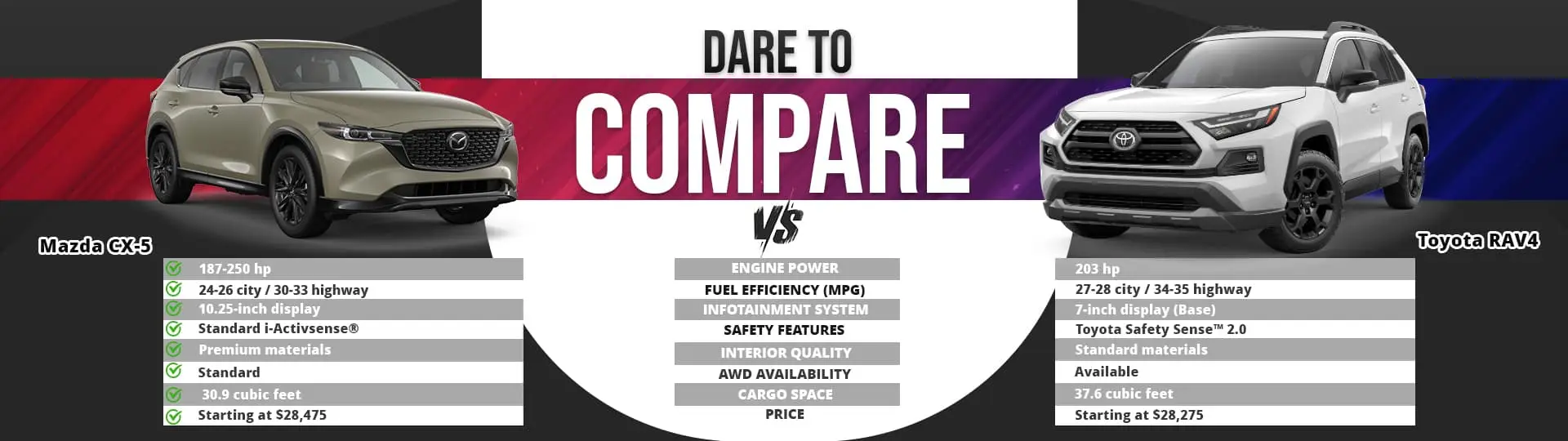
Choosing among engine options in the Toyota RAV4 depends on how you drive and what you need from a vehicle.
Which engine fits which use case
- Daily city commute: Hybrid or RAV4 Prime for best fuel savings in stop-and-go traffic.
- Mixed commuting and highway: 2.5L gasoline balances fuel economy and ease of ownership.
- Tow and haul: Historically the V6 had stronger towing numbers, but RAV4 Prime and higher-output hybrids can handle light towing; check tow ratings for your model year.
- Performance and quick acceleration: RAV4 Prime is the top performer, with brisk off-the-line acceleration.
Tips
- Always check the model year tow rating if towing is a priority.
- Real-world fuel economy varies by driving style and conditions; hybrids shine in urban loops.
Maintenance, reliability, and ownership costs
Toyota’s reputation for durability applies across many RAV4 engines, but costs and needs differ.
Maintenance overview by engine type
- Gasoline 2.5L: Lower routine service costs and easy repairs. Long-lived if maintained.
- Hybrid systems: Higher initial cost but can lower fuel costs. Hybrid components are durable, but battery replacement is an infrequent, high-cost event.
- Plug-in hybrid: Similar to hybrids but with added EV charging considerations and potentially higher repair costs.
- Diesel: May require specialized service and periodic emissions equipment care.
Ownership tips from experience
- Keep up with scheduled service intervals to avoid compounding issues.
- For hybrids and PHEVs, factor in the value of fuel savings vs. higher purchase and service costs.
- Use reputable shops familiar with Toyota electrified systems if you own a hybrid or PHEV.

How to choose the right engine for you
Match the engine options in the Toyota RAV4 to your daily needs with this short checklist.
Ask yourself these questions
- How many miles do I drive each day, and are they mostly city or highway?
- Do I have reliable access to a charging point for a PHEV?
- Do I need towing capability, and if so, how much?
- Is lower long-term fuel cost more important than lower upfront price?
- Choose RAV4 Prime if you want maximum efficiency and performance and can charge regularly.
- Choose RAV4 Hybrid if you want great fuel economy without frequent charging.
- Choose the 2.5L gasoline if you want simplicity and lower purchase cost.
- Consider diesel only if it’s common in your region and you prioritize highway economy and torque.
Personal recommendation: For most buyers who commute inside a city and have home charging, the RAV4 Hybrid or Prime is the best balance of economy and everyday usability. For buyers wanting minimal complexity, stick with the 2.5L gas model.

Frequently Asked Questions of What engine options are available in the Toyota RAV4?
What is the most fuel-efficient engine in the RAV4?
The RAV4 Prime (plug-in hybrid) offers the best overall efficiency thanks to its electric-only range. For non-plug-in options, the RAV4 Hybrid is the most fuel-efficient in daily driving conditions.
Does the RAV4 have a V6 engine option?
Older RAV4 generations offered a V6 in some markets, but modern RAV4s primarily use four-cylinder gasoline and hybrid powertrains. The current lineup focuses on 2.5L four-cylinders and electrified variants.
How much electric range does the RAV4 Prime have?
The RAV4 Prime typically has around 40+ miles of EPA-rated electric-only range in U.S. testing. Real-world range depends on driving style, temperature, and load.
Are diesel RAV4 engines available in the U.S.?
Diesel RAV4 engines are generally not offered in the U.S. market; they are available in various international regions. U.S. buyers mainly choose gasoline, hybrid, or plug-in hybrid models.
Which RAV4 engine is best for towing?
If you plan to tow often, check your model year’s official tow rating. Hybrids and the Prime can handle light towing, while older V6 models offered stronger towing capacity historically.
Conclusion
Toyota gives buyers clear engine choices across the RAV4 family: a reliable 2.5L gasoline engine, efficient hybrid systems, a high-performance plug-in hybrid, and region-specific diesel options. Pick the gasoline 2.5L for simplicity and low ownership cost, the hybrid for steady fuel savings, and the Prime for electric range plus strong power. Think about your daily miles, charging access, and towing needs to guide your choice.
Take action: test drive the engines you’re considering, compare total cost of ownership, and weigh the real-world benefits. If you found this guide useful, leave a comment with your driving needs or subscribe to get more practical car-buying advice.