Winches are everywhere—from off-road vehicles to ships, construction sites, and rescue operations. But if you’re new to winching, one detail stands out: winch capacity rating. This number is more than just a sticker on your equipment; it’s the line between safety and disaster, between stuck and saved. Understanding what winch capacity rating means, how it’s calculated, and why it matters can make the difference in choosing the right winch and using it correctly.
Many people make mistakes when picking a winch because they misunderstand the rating. They think higher numbers always mean better, or that the rating is just a guideline. In reality, winch capacity is a technical limit, and using a winch beyond its rated capacity can lead to equipment failure—or worse, injuries.

49% off Today's Exclusive Deals
Limited-time Exclusive Deals. Check current discount on Amazon.
Check Price on Amazon As an Amazon Associate I earn from qualifying purchases.This article covers everything you need to know about winch capacity rating. You’ll learn how the rating is calculated, why it matters, how to choose the right winch for your needs, and common mistakes to avoid. We’ll use simple language, practical examples, and clear explanations so you can make confident decisions, even if you’re new to the topic.
What Is Winch Capacity Rating?
The winch capacity rating is the maximum load (weight) a winch can safely pull. This is usually measured in pounds (lbs) or kilograms (kg). For example, a winch rated at 10,000 lbs can safely pull up to 10,000 pounds, but not more.
Manufacturers test winches under controlled conditions to determine this number. The rating tells you the maximum pulling force the winch can handle without damage or risk of failure. It includes the strength of the winch’s motor, gears, cable, and mounting hardware.
49% off Today's Exclusive Deals
Limited-time Exclusive Deals. Check current discount on Amazon.
Check Price on Amazon As an Amazon Associate I earn from qualifying purchases.Why Is Winch Capacity Important?
The winch capacity rating is critical for safety. If you try to pull more weight than the winch is rated for, several things can happen:
- Cable snapping: The winch cable or rope can break, which can cause injuries or property damage.
- Motor overheating: The winch motor may overheat and burn out.
- Gear failure: The internal gears can break, making the winch unusable.
- Mounting failure: The winch can tear free from its mount, causing dangerous situations.
Always respect the winch’s rated capacity. It’s not just a suggestion—it’s the maximum safe limit.
How Is Winch Capacity Calculated?
Winch capacity rating is determined by measuring the line pull—the force the winch can exert at the first layer of cable wrapped around the drum. The calculation takes into account several factors:
Key Factors In Winch Capacity
- Motor power: Stronger motors can pull heavier loads.
- Gear ratio: The design of the gears affects pulling force.
- Drum size: Larger drums can hold more cable but may reduce force as layers build up.
- Cable strength: The rope or cable must be rated for the same or higher load.
- Mounting strength: The winch must be securely attached to withstand high forces.
Line Pull Explained
The line pull is the force the winch can apply to a load. Manufacturers measure line pull at the first cable layer because the pulling force decreases with each extra layer of cable. As cable builds up on the drum, the drum diameter increases, which reduces the mechanical advantage.
49% off Today's Exclusive Deals
Limited-time Exclusive Deals. Check current discount on Amazon.
Check Price on Amazon As an Amazon Associate I earn from qualifying purchases.For example, a winch rated at 12,000 lbs at the first layer may only pull 9,000 lbs at the fourth layer.
Typical Winch Capacity Ratings
Winch capacity ratings usually range from:
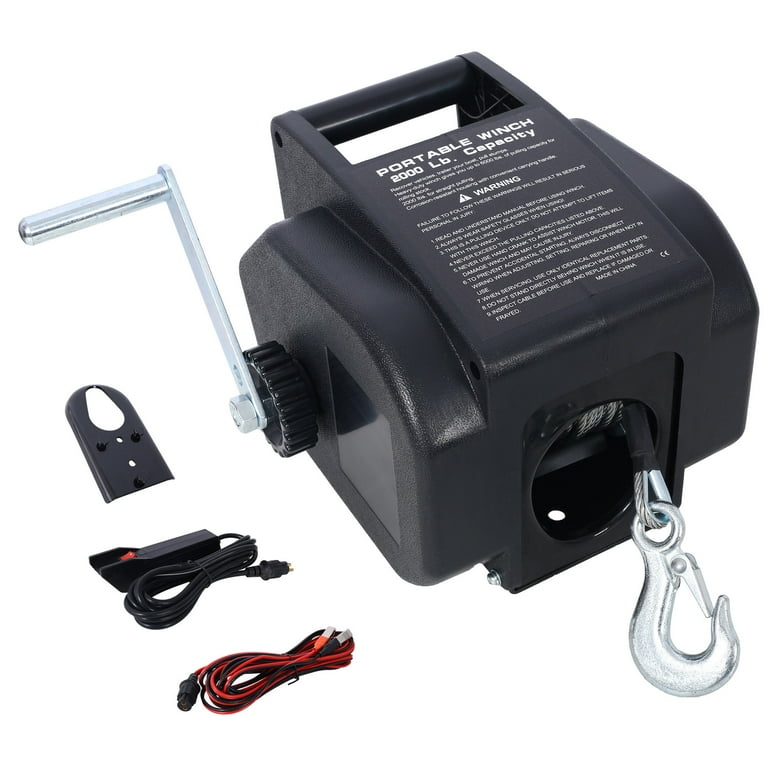
- 2,000–4,500 lbs: Small ATVs, UTVs, and utility winches
- 8,000–12,000 lbs: Most off-road vehicle winches
- 15,000–20,000 lbs: Heavy trucks, trailers, and industrial winches
- Over 20,000 lbs: Winches for boats, ships, and large equipment
Real-world Examples Of Winch Capacity
Let’s look at a few practical situations:
Example 1: Off-road Vehicle Recovery
You have a Jeep weighing 4,500 lbs, but you’re stuck in mud. Should you buy a 4,500 lbs winch? Actually, you need more capacity because mud, slopes, and resistance increase the load. A common rule: choose a winch rated for 1.5 times your vehicle’s weight.
So for a 4,500 lbs Jeep:
- 4,500 lbs x 1.5 = 6,750 lbs
- A 8,000 lbs winch is a safer choice.
Example 2: Utility Winch For Trailers
If you want to pull a 2,000 lbs boat onto a trailer, a 2,000 lbs winch might work—but only on flat ground and with no extra resistance. If the ramp is steep or the boat is stuck, the load increases.
Always add extra capacity for safety.
Example 3: Industrial Winch
A construction site uses a winch to lift building materials. Materials weigh 10,000 lbs, but the winch must pull vertically, which is harder. The site uses a 15,000 lbs winch for safety and reliability.
Factors That Affect Winch Capacity In Practice
The winch capacity rating is a starting point, but real-world conditions can change how much weight you can actually pull.
Terrain And Resistance
- Mud, sand, snow: These increase the resistance, making the load heavier than its actual weight.
- Slopes: Pulling up a hill increases the force needed.
- Obstacles: Rocks, roots, or debris can add resistance.
Cable Layers
As cable wraps around the winch drum, the effective pulling force decreases. The first layer has the highest force, but each layer reduces mechanical advantage.
Here’s a comparison of line pull at different cable layers:
| Cable Layer | Line Pull (lbs) |
|---|---|
| 1st Layer | 10,000 |
| 2nd Layer | 9,000 |
| 3rd Layer | 8,000 |
| 4th Layer | 7,000 |
This reduction is often overlooked by beginners.
Friction
Friction from pulleys, rollers, or cable guides can reduce the effective pulling force. Make sure all parts are well maintained.
Electrical Supply
For electric winches, low battery voltage can reduce pulling force. If your vehicle battery is weak, the winch may not perform as expected.
How To Choose The Right Winch Capacity
Picking the right winch means balancing your needs and safety. Here’s how to make a smart choice:
1. Know Your Load
Find out the actual weight you need to pull. For vehicles, check the gross vehicle weight (GVW), not just the empty weight.
2. Add Safety Margin
Multiply the load weight by 1. 5 (or even 2 for difficult conditions). This gives you a safe minimum winch capacity.
3. Consider Usage
- Frequent heavy pulls: Choose a higher-rated winch for reliability.
- Occasional light pulls: You can use a winch closer to your minimum requirement.
4. Think About Mounting
The winch must be mounted securely. Check your bumper or frame’s strength. If the mounting is weak, even a strong winch won’t help.
5. Cable Type
Winches use steel cable or synthetic rope. Both must be rated for the winch’s capacity. Synthetic rope is lighter and safer but can be damaged by heat and abrasion.
6. Electrical System
For electric winches, check your vehicle’s battery and alternator. High-capacity winches draw lots of current.
Comparison Table: Vehicle Weight Vs Recommended Winch Capacity
| Vehicle Type | Typical Weight (lbs) | Recommended Winch Capacity (lbs) |
|---|---|---|
| ATV/UTV | 1,000–2,000 | 2,500–4,500 |
| Small SUV | 3,000–4,500 | 6,000–8,000 |
| Full-size Truck | 5,000–7,000 | 8,000–12,000 |
| Heavy-duty Truck | 8,000–10,000 | 12,000–15,000 |
Common Mistakes When Using Winch Capacity Ratings
Many beginners assume the winch can pull its rated capacity no matter the situation. This is a mistake. Here are some common errors:
1. Ignoring Terrain
Winch ratings are tested on flat, smooth surfaces. Mud, sand, or hills can double the force needed.
2. Overestimating Cable Strength
Just because the winch is rated for 10,000 lbs doesn’t mean the cable is. Always check cable rating.
3. Forgetting About Mounting
If the winch is not properly mounted, the mounting point can fail before the winch does.
4. Using All Cable Layers
Pulling with all cable layers wrapped around the drum reduces capacity. Always try to pull with the cable close to the drum (first layer).
5. Battery Issues
For electric winches, a weak battery means less pulling power. Always check battery health before heavy pulls.
6. Not Using Snatch Blocks
A snatch block is a pulley that doubles the winch’s pulling force. Not using it means you might overload your winch.
Advanced Tips And Non-obvious Insights
Most guides stop at the basics, but two things often surprise beginners:
Snatch Block Use For Higher Loads
A snatch block can double the pulling force of your winch without upgrading to a higher-capacity model. For example, a 5,000 lbs winch with a snatch block can pull 10,000 lbs (with proper setup). This is useful for heavy or stuck loads.
Layer Management
If you know you’ll need maximum force, unwind most of the cable so the pull starts at the first layer. Many people forget this and lose up to 30% pulling power.
Example: Snatch Block Calculation
Suppose your winch is rated at 8,000 lbs. Using a snatch block:
- Pulled load = 8,000 lbs x 2 = 16,000 lbs (if the cable and mount can handle it)
But always check the snatch block and cable ratings. Don’t overload them.
Winch Capacity Vs. Other Ratings
Winch capacity rating is not the only important number. Here are other ratings you should know:
Winch Duty Cycle
The duty cycle tells you how long the winch can run before overheating. For example, a winch may run for 2 minutes, then needs to cool for 10 minutes. Always check this before long pulls.
Cable Breaking Strength
The breaking strength is the maximum force the cable can take before snapping. This is usually higher than winch capacity, but never use the cable to its breaking point.
Mounting Hardware Ratings
Bolts, brackets, and mounts must be rated for the winch’s capacity. Weak mounts can fail even if the winch is strong.
Safety Guidelines For Using Winch Capacity
Safety is the most important part of winching. Here’s how to stay safe:
- Never exceed winch capacity: Always stay below the rated limit.
- Wear gloves: Steel cables can have sharp frays.
- Use a winch damper: Put a heavy blanket or damper on the cable to reduce recoil if it snaps.
- Stand clear: Never stand near the cable under tension.
- Inspect equipment: Check cable, winch, and mounts before every use.
- Use snatch blocks for heavy loads: They increase safety and pulling power.
Comparing Popular Winch Models By Capacity
Here’s a look at some popular winch models and their capacity ratings:
| Brand | Model | Capacity (lbs) | Typical Use |
|---|---|---|---|
| Warn | VR EVO 12 | 12,000 | Full-size trucks |
| Smittybilt | XRC Gen3 | 9,500 | SUVs, light trucks |
| Superwinch | Tigershark 9500 | 9,500 | Jeep, off-road |
| Badland | ZXR 12,000 | 12,000 | Heavy-duty trucks |
| Champion | 4000-lb ATV/UTV Winch | 4,000 | ATVs, UTVs |
Winch Capacity In Marine And Industrial Applications
Winch capacity is not just for vehicles. In marine and industrial settings, the ratings are often much higher.
Marine Winches
Boat winches can be rated at 20,000 lbs or more. These winches pull ships, anchors, or heavy cargo.
Industrial Winches
On construction sites or factories, winches may pull loads over 50,000 lbs. These are used for cranes, elevators, or moving large equipment.
Maintenance And Winch Capacity
Proper maintenance keeps your winch working at its rated capacity. Here’s what to check:
- Cable condition: Look for frays, rust, or broken strands.
- Motor health: Listen for odd noises or overheating.
- Gear lubrication: Gears should be well-oiled.
- Mounting bolts: Tighten bolts and check for cracks.
- Electrical connections: For electric winches, keep wires clean and tight.
Regular maintenance prevents sudden failures and keeps you safe.
Upgrading Or Replacing Your Winch
Sometimes your needs change. If you upgrade your vehicle or start pulling heavier loads, you may need a higher-capacity winch.
Signs You Need A New Winch
- Winch stalls or overheats: If your winch struggles with your current loads, upgrade.
- Cable frequently frays: This means the winch is overloaded.
- Mounting hardware fails: Stronger winch may need stronger mounts.
- Battery drains quickly: Upgrade battery or winch for electric models.
Always choose a winch with enough capacity for your new needs.
Environmental And Legal Considerations
In some places, using a winch for certain loads is regulated by law. For example, industrial winching may require certified equipment and regular inspections.
Environmental Impact
Synthetic ropes are safer for the environment, but they must be disposed of properly. Steel cables can rust and cause pollution.
Legal Requirements
Check local rules for winch use, especially in industrial or marine settings. You may need permits or inspections.

Frequently Asked Questions
What Happens If I Exceed My Winch’s Capacity Rating?
Exceeding the capacity can cause cable snapping, motor burnout, or gear failure. It’s dangerous for both you and your equipment. Always stay below the rated limit.
How Do I Know The Right Winch Capacity For My Vehicle?
Multiply your vehicle’s weight by 1.5 to find the minimum recommended winch capacity. For heavy conditions, use a factor of 2.
Can I Use A Snatch Block To Increase My Winch’s Capacity?
Yes, a snatch block can effectively double your winch’s pulling force. Make sure the snatch block and cable are rated for the higher load.
Is The Winch Capacity Rating The Same As Cable Strength?
No, the winch capacity rating is the max force the winch can pull. The cable strength is its breaking point. Always check both ratings.
Where Can I Learn More About Winch Safety And Standards?
Check the official Wikipedia Winch page for technical details, history, and safety standards.
Winch capacity rating is not just a number—it’s the foundation of safe, effective winching. Understanding how ratings work, what affects them, and how to choose the right winch will help you avoid mistakes and stay safe. Whether you’re pulling a stuck vehicle, moving heavy equipment, or working on a boat, always respect the winch’s capacity and follow best practices.
With the right knowledge, your winch will serve you reliably for years to come.