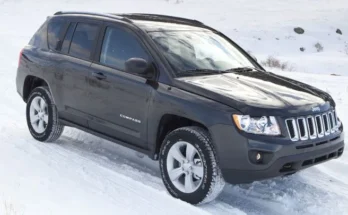
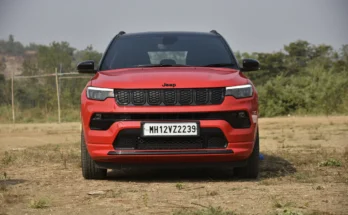
Choosing between the Jeep Grand Cherokee and the Grand Cherokee L can feel like a subtle distinction, but it's one that profoundly impacts your daily driving experience. The core question of what is the difference between Grand Cherokee and Grand Cherokee L often comes down to a single, significant factor: space. Whether you need to comfortably fit more family members or simply appreciate more room for gear, understanding these differences is key.
Manufacturer specifications indicate that while both offer Jeep's renowned capability and luxury, the Grand Cherokee L extends the vehicle's footprint to accommodate an additional seating row. This fundamental change opens up new possibilities for how you use your SUV.

49% off Today's Exclusive Deals
Limited-time Exclusive Deals. Check current discount on Amazon.
Check Price on Amazon As an Amazon Associate I earn from qualifying purchases.Quick Insight: Space is the Big Difference
The primary distinction between the Jeep Grand Cherokee and the Grand Cherokee L is passenger and cargo volume. The Grand Cherokee L features an extended wheelbase and body, adding a third row of seating and significantly more overall space. This makes the L model a 6- or 7-passenger vehicle, while the standard Grand Cherokee typically seats five.
Grand Cherokee: The Classic SUV Experience
The standard Jeep Grand Cherokee has long been a benchmark for a premium, capable SUV. It strikes a balance between everyday comfort and rugged ability, making it a versatile choice for many drivers. This model offers a refined interior, advanced technology, and the legendary off-road prowess Jeep is known for, all within a more traditional SUV package.
Features and What to Expect
Inside the standard Grand Cherokee, you'll find a thoughtfully designed cabin focused on comfort and driver-centric controls. It typically features high-quality materials, intuitive infotainment systems, and a suite of available driver-assistance features designed to enhance safety and convenience. Seating is generally arranged for five passengers across two rows, providing ample legroom and headroom for most families.
49% off Today's Exclusive Deals
Limited-time Exclusive Deals. Check current discount on Amazon.
Check Price on Amazon As an Amazon Associate I earn from qualifying purchases.Cargo space is generous for daily errands and weekend getaways, though it's less than what the extended version offers.
Who is the Standard Grand Cherokee Best For?
Our research suggests the standard Grand Cherokee is an excellent fit for individuals, couples, or smaller families of four who prioritize a luxurious and capable SUV without needing a third seating row. It's ideal for those who appreciate Jeep's off-road heritage and refined on-road manners but don't regularly ferry more than five people. If you value a slightly more compact footprint for easier maneuverability in urban environments, this model likely aligns better with your needs.
It’s also a strong contender for buyers who might consider alternatives like the Toyota RAV4 trim levels.
49% off Today's Exclusive Deals
Limited-time Exclusive Deals. Check current discount on Amazon.
Check Price on Amazon As an Amazon Associate I earn from qualifying purchases.Image source: Web (Bing) / kellyjeepchrysler.net (Web image (fair-use with source credit))
Grand Cherokee L: The Extended Family Hauler
The Grand Cherokee L represents an evolution of the nameplate, designed specifically to cater to larger families or those who frequently transport more passengers. By extending the vehicle's length and wheelbase, Jeep has created a more spacious interior capable of accommodating up to seven occupants across three rows. This makes it a compelling option for those who find themselves outgrowing traditional five-seater SUVs.
Features and What to Expect
The Grand Cherokee L builds upon the luxury and technology of the standard model but amplifies the passenger experience. The key feature is the third-row seating, offering flexible configurations often including second-row captain's chairs for easier access and enhanced comfort. Manufacturer specifications confirm a noticeable increase in overall interior volume, translating to more legroom in the rear rows and a significantly larger cargo area, especially when the third row is folded.
Expect similar premium materials and advanced tech features, all scaled to support a larger passenger capacity.
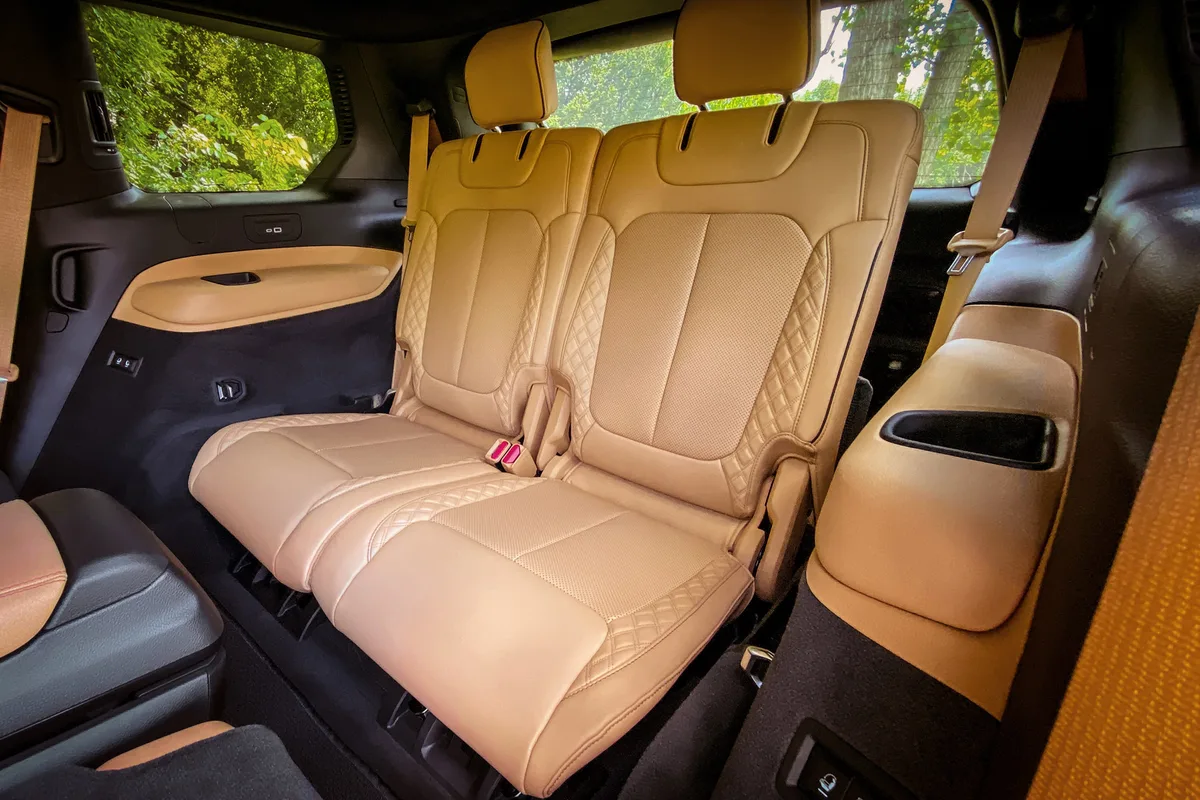
Image source: Bing (Web (fair-use with source credit))
Who is the Grand Cherokee L Best For?
Aggregate reviews indicate the Grand Cherokee L is best suited for larger families, carpoolers, or anyone who regularly needs to transport six or seven people. If you have children, often travel with extended family, or frequently take group outings, the added seating capacity is a significant advantage. It’s a direct answer for those seeking a more spacious alternative to standard SUVs, offering a premium Jeep experience for a bigger crew.
This makes it a strong consideration when looking at larger luxury SUVs or comparing it to alternatives like the Range Rover Sport.
Side-by-Side Comparison: Key Differences
When you're weighing your options, the most significant differences between the Grand Cherokee and the Grand Cherokee L come down to how much space you need and how you plan to use your vehicle. While both share the Jeep DNA of capability and refinement, the L's extended design directly impacts passenger accommodation and cargo flexibility. Understanding these distinctions is crucial for making the right choice.
Passenger Space and Seating
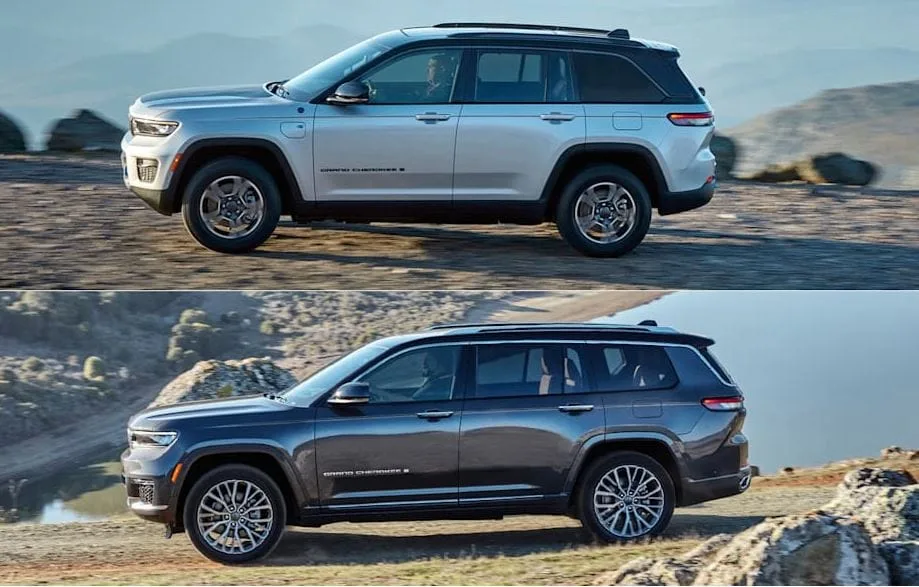
The most obvious difference lies in seating capacity. The standard Grand Cherokee is a two-row SUV designed to comfortably seat up to five people. This configuration is more than adequate for most families and everyday use.
In contrast, the Grand Cherokee L stretches out to offer a three-row seating arrangement, typically accommodating six or seven passengers. This is achieved through a longer wheelbase and body, providing a usable third row where passengers can sit without feeling overly cramped, especially for shorter trips. Some L models even offer second-row captain's chairs, which can improve access to the third row and offer a more premium feel for those second-row occupants.
Manufacturer specifications confirm the L's interior volume is substantially greater to house this extra seating.
Cargo Room and Versatility
This is where the Grand Cherokee L truly flexes its muscles. With the third-row seats in use, cargo space behind them is more limited, comparable to what you might find in smaller compact SUVs. However, the real advantage of the L comes when you fold down those third-row seats.
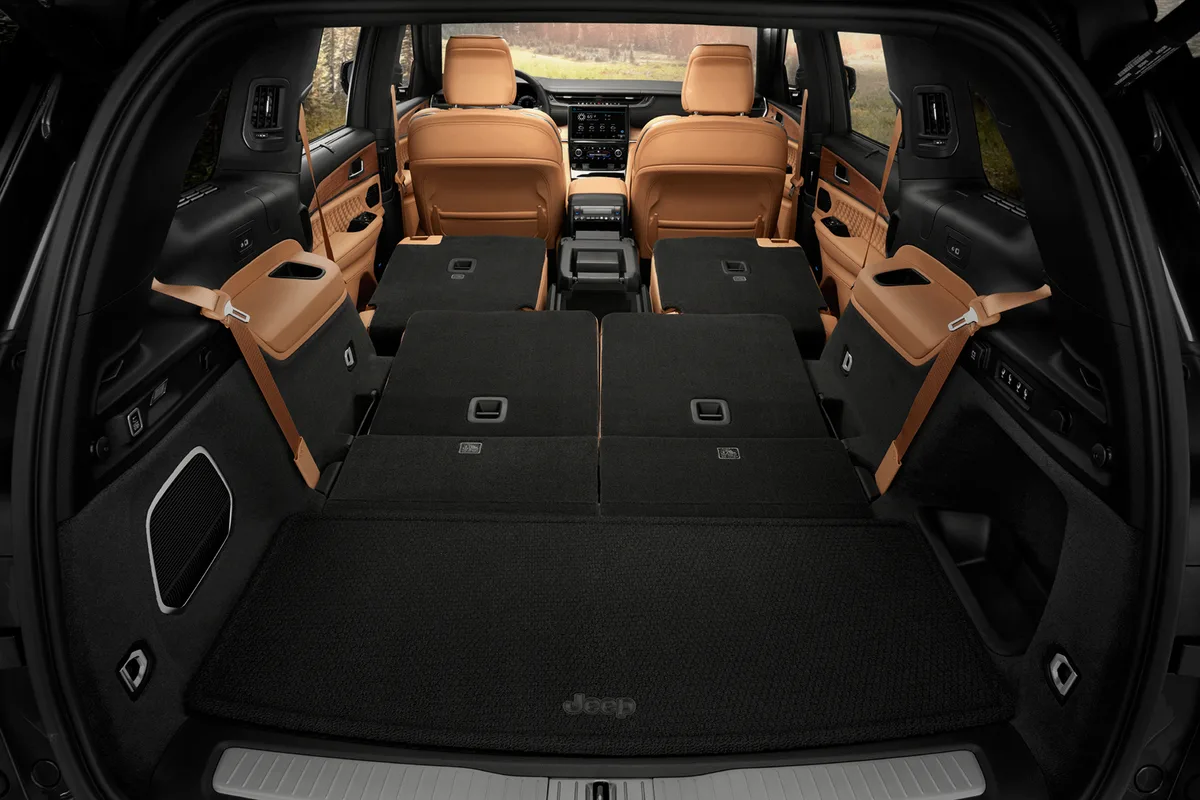
Image source: Web (Bing) / elkgrovecdjr.com (Web image (fair-use with source credit))
Folding the third row dramatically expands the cargo area, making it significantly larger than the standard Grand Cherokee's maximum cargo capacity. This increased volume makes the L exceptionally versatile for hauling larger items, such as furniture, sports equipment, or luggage for a full family road trip. The standard Grand Cherokee still offers good cargo space for daily needs and moderate hauling, but it simply cannot match the sheer volume available in the L when the extra seats are stowed.
Driving Dynamics and Maneuverability
While both vehicles share a similar driving feel thanks to Jeep's focus on comfort and refinement, the difference in size can influence how they handle. The standard Grand Cherokee, with its shorter wheelbase, generally offers a slightly more nimble feel. It can be easier to maneuver in tight parking lots, navigate narrow city streets, and park in smaller spaces.
The Grand Cherokee L, being longer, requires a bit more spatial awareness. Parking in a crowded garage or executing a U-turn might require more deliberation. However, Jeep has engineered both models to provide a smooth and composed ride, so neither feels unwieldy on the highway.
For buyers who frequently drive in congested urban areas, the standard model's more compact dimensions might be a deciding factor.
Pricing and Value
As of 2026, manufacturer pricing typically places the Grand Cherokee L at a higher starting point than the standard Grand Cherokee. This premium reflects the extended platform, additional seating, and increased interior volume. When considering the overall value, it's essential to assess your specific needs.
If you require the extra seating and cargo capacity, the Grand Cherokee L offers considerable utility for its price point, especially when compared to other three-row SUVs. For those who don't need the extra space, the standard Grand Cherokee provides a more budget-friendly entry into the Grand Cherokee ownership experience. Our research indicates that buyers focused on value often weigh the cost against their actual passenger and cargo requirements to determine which model offers the best return for their investment.
Mistakes to Avoid When Choosing Between Them
One of the most common mistakes people make when deciding between the Grand Cherokee and Grand Cherokee L is overestimating or underestimating their actual passenger and cargo needs. If you only occasionally carry more than five people, the added length and cost of the Grand Cherokee L might not be justified. You could end up paying more for a vehicle that's slightly less maneuverable and uses more fuel than you strictly need.
Conversely, if you frequently find yourself needing to transport more than five people or hauling larger items, choosing the standard Grand Cherokee could lead to frustration. You might struggle to fit everyone comfortably, or find yourself needing to make multiple trips for groceries or sports gear. It's important to honestly assess your typical usage patterns, not just your idealized scenarios.
Considering alternatives like the Honda CR-V trim levels can also highlight what you might be missing if you opt for a smaller vehicle when more space is truly required.
Common Questions About the Grand Cherokee and Grand Cherokee L
How much does the Grand Cherokee L cost compared to the standard Grand Cherokee?
The Grand Cherokee L typically has a higher starting price than the standard Grand Cherokee. This reflects the longer wheelbase, additional third row of seating, and increased overall interior volume. For instance, base models for the L can be several thousand dollars more than comparable trims of the standard Grand Cherokee.
Does the Grand Cherokee L offer different engine options than the standard Grand Cherokee?
While both models often share similar engine lineups, specific availability can vary by model year and trim level. It's always best to check the latest manufacturer specifications for the exact engine options available for each vehicle. However, the core difference remains in the body and wheelbase, not necessarily the powertrain itself.
Is the Grand Cherokee L harder to drive in the city?
Yes, generally, the Grand Cherokee L is somewhat harder to drive in city conditions compared to the standard Grand Cherokee. Its longer wheelbase and overall length mean it requires more space for turning and parking. Drivers may need to be more mindful of their surroundings in tight urban environments.
Which model is better for off-roading?
Both the Grand Cherokee and Grand Cherokee L are designed with Jeep's legendary off-road capabilities in mind. The underlying chassis and available four-wheel-drive systems are often similar. However, the standard Grand Cherokee’s shorter wheelbase might give it a slight advantage in certain extreme off-road scenarios due to better approach and departure angles, though the L remains highly capable.
How does the fuel economy compare?
Due to its larger size and greater weight, the Grand Cherokee L typically has slightly lower fuel economy ratings than the standard Grand Cherokee. This difference can be noticeable over time, especially for drivers who do a lot of city driving or frequent long commutes. Always consult the official EPA estimates for the most accurate comparison for specific model years.
Your Decision Guide: Making the Final Call
Deciding between the Jeep Grand Cherokee and its extended sibling, the Grand Cherokee L, boils down to your fundamental needs. If you have a smaller family, rarely transport more than five people, or prioritize a slightly more compact and agile vehicle for city driving, the standard Grand Cherokee is likely your best bet. It offers the premium Jeep experience without the added length and cost that might go unused.
However, if your household frequently includes more than five people, you often carpool, or you need significant cargo flexibility for larger items or family trips, the Grand Cherokee L is the clear choice. Its three-row seating and expanded cargo area provide the space and versatility required for larger groups and bulkier loads. Consider the implications for towing capacity as well; while both are capable, the overall size of the L might influence its suitability for certain towing applications, though manufacturer specs on towing capacity are generally robust for both.