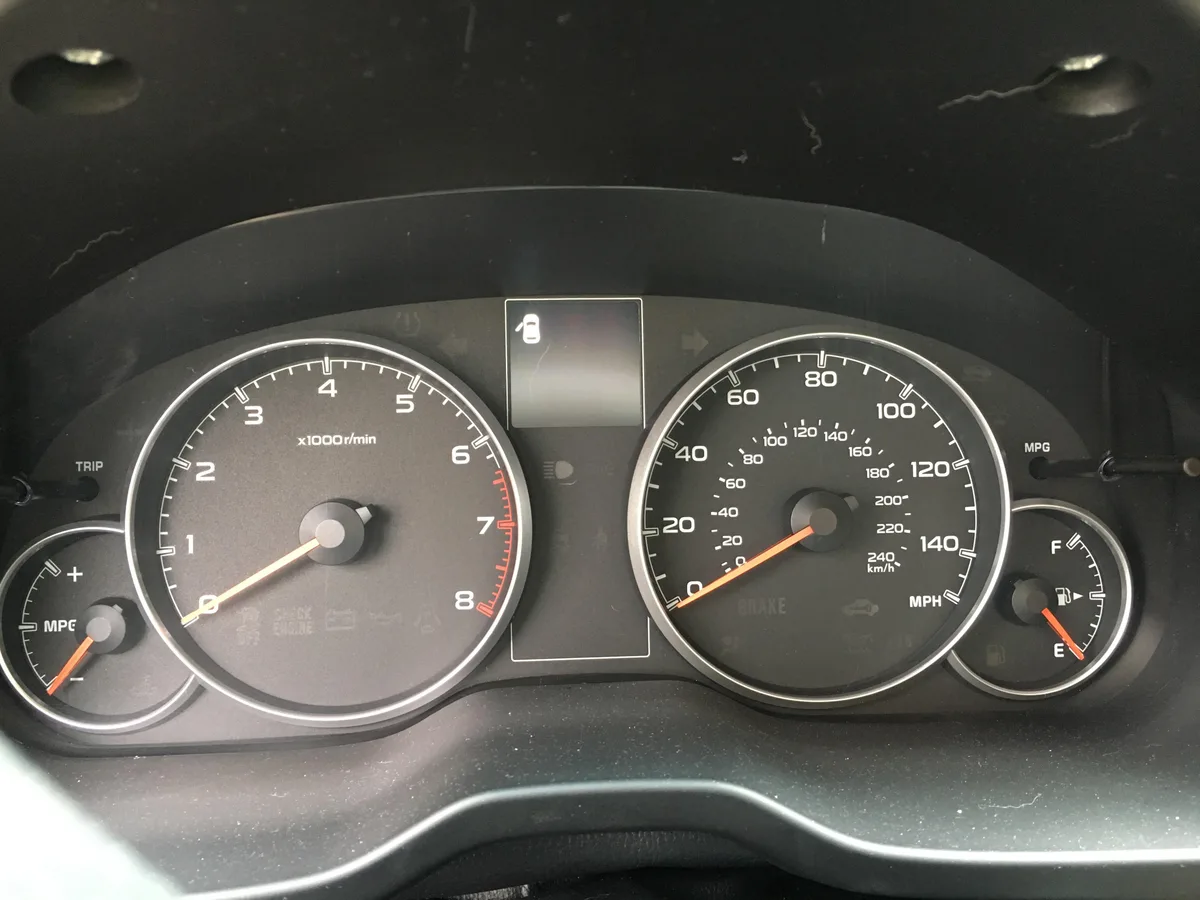
Your Subaru Outback's temperature gauge just climbed past the middle, and now you're wondering if you can make it home. Subaru Outback engine overheating is one of the most common issues owners face, especially on older EJ25 models. The good news is that most causes follow a clear pattern.
The bad news is that ignoring it can wreck the engine.

49% off Today's Exclusive Deals
Limited-time Exclusive Deals. Check current discount on Amazon.
Check Price on Amazon As an Amazon Associate I earn from qualifying purchases.Manufacturer specifications indicate the EJ25's thermostat usually opens around 190°F, with normal operation sitting between roughly 180°F and 220°F. Much above that, and the cooling system is telling you something is wrong. As of 2026, many Outbacks on the road are over a decade old, so age-related cooling system failures are becoming the rule rather than the exception.
Let's walk through what to check first.
49% off Today's Exclusive Deals
Limited-time Exclusive Deals. Check current discount on Amazon.
Check Price on Amazon As an Amazon Associate I earn from qualifying purchases.Image source: Bing (Web (fair-use with source credit))
Why Your Outback Is Overheating: Read These Symptoms First
If the gauge climbs past normal, your next move depends on the pattern. Don't open the hood and start pulling parts yet. Read the symptoms first, because each pattern points to a different failed component.
- Sudden spike at highway speed. That usually means a coolant leak, a bad radiator cap, or a failing water pump.
- Heat builds only at idle. Then the radiator fan, fan relay, or fan fuse is almost always the problem.
- Slow temperature creep on long grades or with a loaded car. You're probably low on coolant, running a partially stuck thermostat, or dealing with a clogged radiator.
- Overheat right after a coolant flush. That's trapped air, not a bad part.
- Bubbles in the overflow tank plus white exhaust smoke. Those are head gasket warning signs.
The key to a Subaru Outback engine overheating diagnosis is to match the symptom to the component. Guessing wastes money. If you notice a puddle under the car, check for a coolant leak before anything else.
The Usual Suspects: Thermostat, Radiator, Fans, Water Pump, Head Gaskets
Most Outback overheating issues trace back to one of five parts. Here's what each one does and how it fails.
49% off Today's Exclusive Deals
Limited-time Exclusive Deals. Check current discount on Amazon.
Check Price on Amazon As an Amazon Associate I earn from qualifying purchases.
Image source: Web (Bing) / animalia-life.club (Web image (fair-use with source credit))
| Part | How it fails | What you'll notice | | Thermostat | Sticks closed | Rapid spike after a few minutes of driving | | Radiator | Cracked plastic end tanks | Low coolant, puddle under the front of the car | | Cooling fans | Relay or motor dies | Heat at idle, drops on the highway | | Water pump | Weeping from the pulley area | Small coolant trail, squealing noise | | Head gasket | Exhaust gas mixes with coolant | Bubbles in overflow, white smoke, milky oil |
The EJ25 engine in older Outbacks has a known reputation for head gasket failure, especially in early-2000s models. The newer FB25 is less prone to that, but its plastic radiator end tanks and weak fan relays still cause plenty of trouble. The flat boxer layout also hides the water pump behind the timing cover, so a small leak can be sneaky.
Check the coolant crossover pipe behind the engine too; it's a common leak point on the EJ25.
Should You Shut It Off Right Now? A Quick Safety Check
If the red warning light is on, the answer is almost always yes. Shut the engine off as soon as you're safely stopped. Continuing to drive on a hot engine can warp the cylinder heads within minutes.
Here's how to decide what to do in the moment.
- If steam or coolant is spraying from under the hood: pull over immediately, kill the engine, and wait at least 30 minutes. Do not open the hood while steam is venting. The coolant is pressurized and hot enough to cause serious burns.
- If the gauge is in the red but no steam: stop, shift to Park, then run the heater at full blast. That pulls heat out of the engine core. Let it idle for a few minutes and watch the gauge. If it drops, you can carefully nurse it to a nearby shop. If it keeps climbing, shut it off.
- If the gauge is just above the middle: you have time. Pull over at the next safe spot and let the engine idle with the heater on. Avoid heavy throttle, hills, and the AC.
Per NHTSA guidance, an overheating engine can also stall or lose power in traffic, creating a crash risk. Treat the red zone as a stop-now event, not a maybe.
The Diagnostic Workflow: Simple Checks Before Any Parts
Work through these steps in order. They cost nothing, and each one removes a suspect.
Let the engine cool completely. Check the coolant level in the plastic overflow tank and, once cold, in the radiator. Use the correct coolant-to-water blend. In our research, many Outback overheating cases turn out to be nothing more than a low overflow tank.
Look for white residue or coolant trails around the radiator cap, upper and lower hoses, water pump, and the coolant crossover pipe behind the engine. If you find one, that's your culprit. Our guide to coolant leaks covers the usual hiding spots.
Pressure test the cooling system. Rent a pressure tester, pump it to the radiator cap rating, and wait 15 minutes. If the needle drops, spray soapy water around the suspected area. Bubbles will pinpoint the leak.
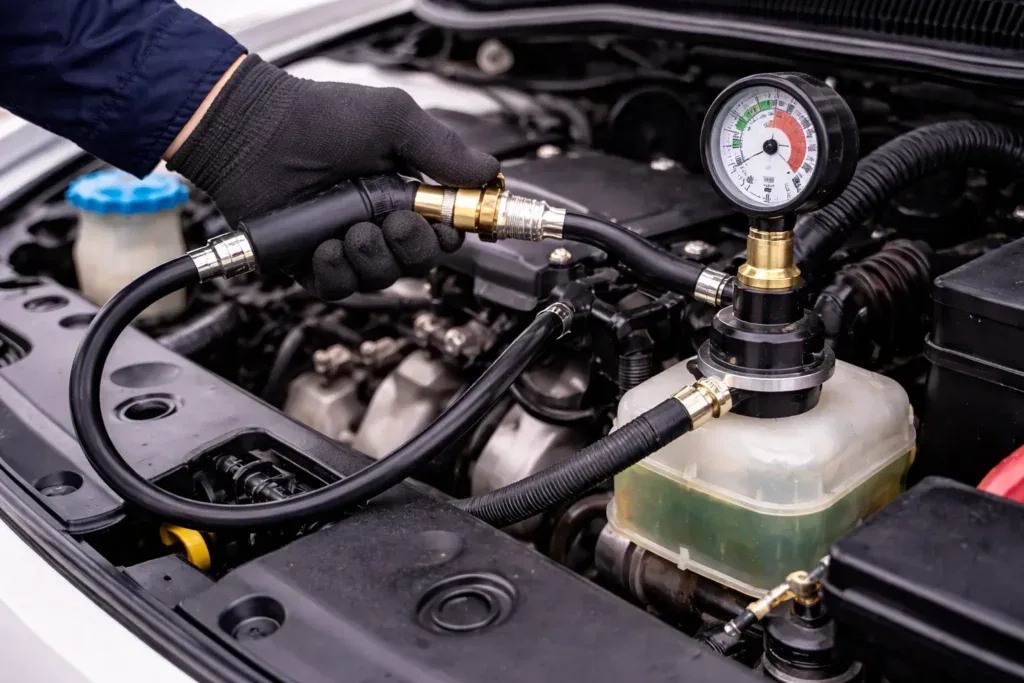
Image source: Bing (Web (fair-use with source credit))
Start the engine cold and remove the radiator cap. Watch for a steady stream of bubbles. That indicates combustion gas is entering the cooling system, which usually points to a head gasket problem.
Check the radiator fans. They should spin up once the engine reaches operating temperature or when the AC is switched on. If they stay off, test the relay, fuse, and fan motor separately. A stalled fan motor is common and easy to replace.
Confirm the gauge is telling the truth. Use an infrared thermometer on the upper radiator hose. If the engine is at a healthy 190°F to 200°F but your dash gauge reads hot, the sensor or wiring is at fault.
When you drain coolant, never pour it down the drain. Collect it in a sealed container and find a recycling drop-off. The EPA offers state-by-state disposal guidance.
Repair Cost Breakdown: DIY vs Shop vs Engine Replacement
Here are typical cost estimates for common Outback cooling repairs as of 2026. Your exact price depends on your region, model year, and shop rate.
| Repair | DIY parts cost | Shop cost (installed) | | Thermostat kit | $30–80 | $200–350 | | Coolant flush | $50–100 | $100–200 | | Water pump replacement | $150–300 | $400–800 | | Radiator replacement | $200–500 | $500–1,000 | | Head gasket repair | $200–500 in parts | $1,500–3,000 | | Used replacement engine | $1,500–3,000 | $3,500–6,000 |
If the head gasket is blown on a high-mileage EJ25, a used engine often makes more financial sense. The labor to replace a head gasket and the labor to swap in a used engine are surprisingly similar. Before committing to either, verify the rest of the car is worth saving.
Check for rust, transmission issues, and other big-ticket wear. That decision is the real fork in the road.
7 Mistakes That Turn a Minor Overheat Into a Blown Engine
You know the causes now. These are the mistakes that turn a $50 fix into a $3,000 engine swap.
- Opening the radiator cap while hot. Pressurized coolant at 220°F can cause severe burns. Let the engine cool completely before touching anything.
- Driving just a few more miles with the gauge in the red. Aluminum heads warp fast. "Just making it home" often means a head gasket job.
- Ignoring a slow coolant loss. A pinhole leak in a heater hose can suddenly open up mid-drive. Top it up today, and it strands you tomorrow.
- Mixing coolant types. Old green with new blue long-life coolant can create sludge. Use Subaru Super Coolant or an equivalent specified for the EJ25 or FB25.
- Skipping the bleeding step. After a flush, trapped air creates a false overheat. Run the engine with the heater on and the radiator cap off until the thermostat opens.
- Replacing parts without pressure testing. A $200 thermostat might be fine when the real problem is a $20 fan relay. The tests don't lie.
- Using the AC to "cool" the engine. The AC adds load and heat. Use the heater instead, or pull over.
The common thread in all seven is impatience. Slow down, verify the diagnosis, and the engine usually survives.
FAQs About Subaru Outback Overheating
Can I drive my Outback with a slight overheat?
No, not worth the gamble. Even a few minutes above normal can weaken the head gasket. Pull over, let it cool, and check the coolant level before moving again.
A short trip to a shop is one thing. A cross-town commute is another.
Why does my Outback overheat when the AC is on?
The AC compressor adds engine load and kicks on the electric fans. If those fans are slow, or the condenser blocks airflow, heat builds quickly. If you notice this pattern, start with the fan relay circuit.
Check the relay, fuse, and motor before anything else.
What coolant does a Subaru Outback need?
Subaru specifies its own Super Coolant, usually blue or pink. The main requirement is a formula with no silicates and no phosphates. Using the wrong type can cause gelling.
Check your owner's manual for the exact spec and change interval.
How much does it cost to fix a Subaru Outback head gasket?
Plan for $1,500 to $3,000 at most shops. The boxer engine layout requires dropping the engine down in the bay to reach the heads. On a high-mileage car, compare that to a used engine swap before committing.
How often should I flush the Outback cooling system?
Subaru recommends coolant replacement roughly every 30,000 miles or 30 months, depending on the model. Hard driving or hot climates mean shorter intervals. If you're unsure, you can use a coolant test strip to check its condition.
Final Decision Guide: What to Do Next for Your Outback
By now, you've matched your symptom to a likely cause and seen what each repair costs. Here's how to decide what comes next.
| What you found | Your next move |
|---|---|
| External coolant leak | Repair the leak, replace the hose or part, flush, and bleed the system. |
| Stuck thermostat | Replace the thermostat and housing gasket with OEM parts. |
| Dead cooling fan circuit | Test the relay, fuse, and motor; replace the failed component. |
| Bubbles in the coolant | Stop driving. Have a shop run a combustion leak test. |
| No obvious cause | Pressure test the system and check the coolant temperature sensor before replacing anything. |
If the engine already overheated into the red, do a compression test before spending any money. A quick check tells you whether the head gasket survived the heat. Many Outbacks get a second life this way, and many more get sold "as-is" when they shouldn't be.
The most important step is the first one: stay calm, verify the failure, and drive only when the gauge says it's safe. Your Outback is tougher than most cars. It just needs you to listen to what it's telling you.