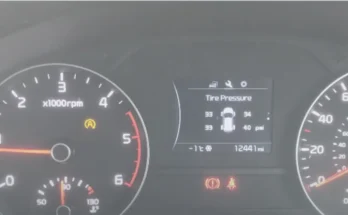
Your Tesla Model Y tire keeps losing air, and you're tired of watching the app drop to 34 psi overnight. The warning pops up on the screen, you reinflate, and three days later it's back. That's not coincidence.
There's a finite list of causes, and we're going to narrow them down.

49% off Today's Exclusive Deals
Limited-time Exclusive Deals. Check current discount on Amazon.
Check Price on Amazon As an Amazon Associate I earn from qualifying purchases.As of 2026, Tesla still recommends 42 psi for cold tires on the Model Y. Most factory tires also carry an acoustic foam liner inside. That combination changes diagnosing completely.
The foam can hide a nail, and a 10°F temperature drop can lower pressure by 1 to 2 psi. Let's sort out what's actually going on.
Why Your Model Y Keeps Losing Air (And Why It Feels Different From Other Cars)
Quick Answer: When your Tesla Model Y tire keeps losing air, the usual causes are a tread puncture, a leaking valve stem, a cracked wheel bead, or simple cold-weather contraction. Check all four pressures in the app, confirm the drop is isolated to one tire, then inspect for an obvious nail.
49% off Today's Exclusive Deals
Limited-time Exclusive Deals. Check current discount on Amazon.
Check Price on Amazon As an Amazon Associate I earn from qualifying purchases.The Model Y isn't like a typical gas car in three ways that matter. First, there's the acoustic foam inside many factory tires. That sound-deadening layer is great on the highway, but it can trap air beside a small puncture.
A nail might be hidden beneath the foam, which makes a standard visual check almost useless.
Second, the TPMS is regulated by NHTSA to warn you when pressure drops roughly 25% below the placard value. For a Model Y, that's around 31.5 psi. You'll get the low-pressure alert before the tire is visibly flat.
Third, there's no spare tire. That single fact changes every roadside decision you'll ever make.
49% off Today's Exclusive Deals
Limited-time Exclusive Deals. Check current discount on Amazon.
Check Price on Amazon As an Amazon Associate I earn from qualifying purchases.If you notice the same tire losing pressure every few days, treat it as a real leak until proven otherwise. It's like a minor fluid leak in an engine. Ignore it long enough, and the fix gets expensive fast.
A slow tire leak always points to a physical problem.
First Step: Is It a Real Leak or Just Cold Weather?
Cold weather is the most common reason a Tesla shows a sudden pressure warning. Air contracts when it cools. For every 10°F drop in ambient temperature, tire pressure drops roughly 1 to 2 psi.
An overnight change from 65°F to 25°F can drop a tire from 42 to 36 psi. That's enough to trigger an alert.
The trick is to compare all four tires. If all four drop equally, that's temperature. If one tire drops twice as fast as the others, you have a leak.
Don't overthink it. The same logic applies to diagnosing grinding brakes: look for the cause before replacing parts.
| Sign | Cold Weather | Real Leak |
|---|---|---|
| Pressure drop | All four tires similar | One tire drops faster than the rest |
| Visual inspection | Nothing unusual | Nail, cut, bulge, or wet spot |
| After refilling | Stays stable until the next cold snap | Drops again within days |
| Warm day | Pressure recovers partially | Stays low |
Always set the pressure to 42 psi when the tires are cold, per Tesla's specifications. If you check the app at sunrise, it will read lower than at noon. That's normal.
That's physics, not a puncture.
Find the Leak: A Step-by-Step Diagnostic Workflow
If one tire keeps losing air, you need to find exactly where it's going. Start simple, then get more technical.
- Check all four pressures. Use the Tesla app or a digital gauge. Write down the numbers. Inflate the low tire to 42 psi.
- Wait 24 hours. Compare again. If the tire lost more than 2 psi overnight, there's a real leak.
- Look for objects. Inspect the tread, sidewall, and shoulder for screws, nails, or cuts. Rotate the wheel so you see the full circumference.
- Listen closely. A slow leak often makes a faint hissing sound. It's much easier to hear in a quiet garage.
- Use soapy water. Mix a few drops of dish soap in a spray bottle. Coat the tread, valve stem, and wheel bead. Bubbles will reveal the exact spot.
- Check the valve stem core. Sometimes the core is loose. A cheap tightening tool can fix it. If bubbles form around the base of the stem, the TPMS sensor gasket is the culprit.
- Inspect the inside. No visible leak on the outside? The tire has to come off the rim. The acoustic foam inside factory Model Y tires can completely mask a puncture.
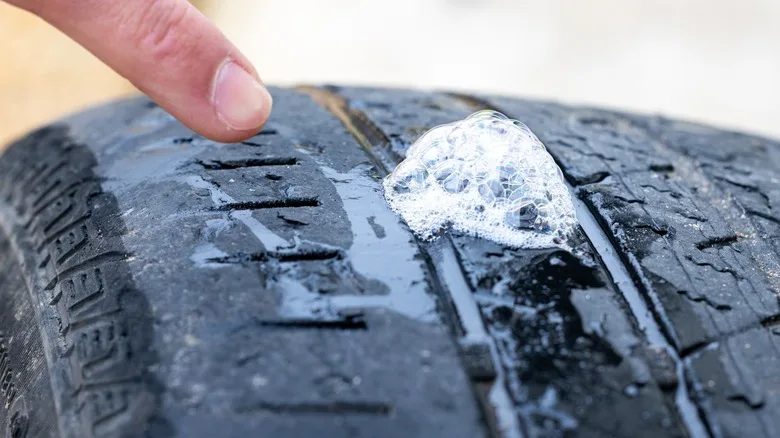
Image source: Bing (Web (fair-use with source credit))
If you need to lift the car, use Tesla jack pucks. They protect the battery pack. A floor jack placed directly on the metal can dent the pack and potentially void your warranty.
That's a costly mistake on top of a tire problem.
Decision Tree: Repair vs. Plug vs. Replace
Now you know where the leak is. Time to decide what to do.
Repair with an internal patch. This is the only permanent fix, according to USTMA guidelines. The shop removes the tire, cleans the inner liner, and applies a combination plug-patch from the inside. Cost is usually $30 to $50.
It's perfect for tread punctures under 1/4 inch, away from the sidewall. On a foam-lined Tesla tire, it takes an extra 15 minutes. That's why some shops refuse.
Ask at the counter before you book.
Plug kit. Plugging from the outside works for emergencies only. A Model Y weighs roughly 4,400 pounds. A plug can work loose under heavy loads.
Plus, if the plug pushes into the acoustic foam, the foam can shift and cause a vibration. Treat it as a temporary fix to get you to a shop. Don't trust it long-term.
Replace. You need a new tire if the puncture is in the sidewall or shoulder. Also replace if the tire was driven flat for more than a mile, if there's a bulge or exposed cord, or if the tread depth is below 2/32 inch. The same goes for foam that's separated from the casing.
| Option | Cost | Lifespan | Best For |
|---|---|---|---|
| Internal patch | $30–$50 | Remaining tread life | Small punctures in the tread center |
| Plug kit | $10–$25 | A few hundred miles max | Getting home in an emergency |
| New tire | $250–$500+ | Full tread life | Sidewall damage, worn tread, or foam failure |
Per the U.S. Tire Manufacturers Association, a tire shouldn't be repaired if the puncture is larger than 1/4 inch or if the tire has worn past its indicators. Those USTMA guidelines are the industry standard.
They exist to prevent tread separation at highway speeds. A tire failure at speed is as urgent as a brake failure. Don't gamble on a cheap fix.
If You're Stranded: Roadside Options, Sealant, and No-Spare Reality
The Model Y has no spare. That's not a secret, but it becomes very real the first time you hear that hissing sound on the shoulder. Tesla's roadside assistance is your best first call.
You can request it through the Tesla app, and a third-party truck will show up, load the car, and take it to a nearby service center.
In the trunk, most Model Ys include an air compressor and a bottle of tire sealant. Only use sealant if you're truly stuck. The stuff coats the inside of the tire, and it can destroy the TPMS sensor in the process.
Replacing a sensor runs about $100 to $150. If you're within reach of help, call roadside instead. If you're in rural territory with no signal, sealant is still better than a dark roadside.
NHTSA requires all modern cars to have a TPMS that warns when pressure drops 25% below the placard. You can read their official TPMS fact sheet to understand the reasoning. It's a safety net, not a maintenance plan.
The Tesla app shows exact psi values for every tire, but it won't fix a slow leak.
If you do use the compressor, inflate to 42 psi. Drive slowly to the nearest shop and tell them a tire lost air. They'll know to check the foam.
That one sentence saves an hour of confusion.
Common Mistakes That Turn a $30 Patch Into a $400 Tire
The foam layer inside factory Model Y tires catches people off guard. A shop might cut open the tire, see the foam, and refuse to patch it. Don't push for a plug as a permanent fix.
Plugs don't seal the inner liner properly on a heavy EV, and they can fail under highway load.
Mistakes We See Repeatedly
- Driving on a flat tire just a few hundred feet. That shreds the sidewall and makes a $30 patch impossible.
- Using tire sealant too early. It coats the TPMS sensor and voids any chance of a clean internal patch.
- Letting a shop skip the foam inspection. Some techs won't bother. You end up with a vibration at 70 mph.
- Overtorquing the lug nuts. The correct spec for a Model Y is 129 lb-ft. Many shops hit it with an impact wrench and go straight past.
- Trusting a plug for more than a few weeks. A plug gets you to the shop. It isn't a repair.
- Refusing a new tire when the sidewall is damaged. Structural damage can't be patched. Full stop.
Image source: Bing (Web (fair-use with source credit))
One more trap: balancing beads or extra weights can break loose inside. Aggregate owner feedback reports a low hum after some patch jobs. If you feel that after a repair, ask the shop to rebalance the tire.
A proper patch job includes that. It's a small detail with big consequences, just like a radiator fan that stops working leads to overheating.
Real Scenario Walkthroughs: What Actually Happens
Scenario 1: Nail in the Tread Center
You wake up to a low-pressure warning. The soapy water test shows a nail in the middle of the tread. This is the best case.
A shop removes the tire, patches it from the inside, and remounts it. Cost: $40. Total time: about an hour.
Drive away and monitor the pressure for 48 hours.
Scenario 2: Sidewall Bulge After a Pothole
You hit a pothole and the tire holds air, but there's a bulge on the sidewall. The internal cords are broken. If you keep driving, the tire can fail without warning.
This one requires a replacement. On a 19-inch Model Y, expect to spend around $300 to $400 for a quality OE-equivalent tire.
Scenario 3: Cold Snap, No Puncture
A cold front drops temps from 70°F to 30°F overnight. All four tires read 35 to 36 psi. No leaks anywhere.
Inflate all four to 42 psi. Check again in a week. If they all stay even, there's no problem.
If one drops again while the others hold, you have a leak.
| Scenario | Clue | Fix | Typical Cost |
|---|---|---|---|
| Tread nail | Visible in soap test | Internal patch | $30–$50 |
| Sidewall damage | Bulge or cut | Replacement tire | $250–$500 |
| Cold weather | All tires low equally | Reinflate to 42 psi | $0 |
Quick FAQ: Tesla Model Y Tire Pressure Problems
Why does my Model Y lose tire pressure overnight?
A single tire losing more than 2 psi overnight indicates a real leak. Common sources are a slow puncture, a cracked wheel bead, a loose valve core, or a damaged TPMS sensor gasket. The soapy water test locates the exact spot.
If nothing shows on the outside, the foam liner is hiding the puncture.
Can I plug a Tesla Model Y tire?
A plug is acceptable as a temporary roadside fix only. The Model Y's weight, roughly 4,400 pounds, puts heavy stress on a plug. It can work loose.
The permanent repair is an internal plug-patch combination applied after the tire is removed. USTMA guidelines recommend that method for all radial tires.
Why does the Tesla app show different pressures for each tire?
Slight differences are normal. Sun exposure, side of the car facing traffic, and tire wear all affect temperature. A gap of 1 to 2 psi between tires is fine.
A difference of 4 psi or more on a cold morning usually points to a leak in that specific tire.
How much does a tire patch cost?
Most independent shops charge $25 to $50 for a patch on a Tesla Model Y. Some dealers charge a bit more because of the foam layer. If a shop tries to charge more than $80, call around.
Also, never let a shop patch a tire with less than 2/32 inch of tread remaining.
Is Tesla roadside assistance worth calling for a flat tire?
Yes. You can request it from the Tesla app while staying in the car. The service will bring a truck and take you to the nearest Tesla-approved shop.
It's covered during the vehicle warranty period. After that, coverage depends on your plan. Still, it's safer than using sealant and risking your TPMS sensor.
What is the correct tire pressure for a Model Y?
The recommended cold inflation pressure for all Model Y trims is 42 psi, or 290 kPa. Check the pressure when tires are cold, meaning the car hasn't been driven for at least three hours. Always match that 42 psi figure before comparing tire wear or diagnosing a leak.